My tabletop game design is deeply inspired by Japanese roleplaying games. In order to more thoroughly understand those roots, I have been playing the mainline Final Fantasy titles and 100% completing them. As part of that process, I’ve created this blog series where I deconstruct each game into lessons for my ttrpgs.
Final Fantasy IV is a dramatic step back in mechanical complexity and self-expression. Despite this, it is widely beloved and frequently heralded as “where Final Fantasy got started” in North America. This is partly due to the fact that Final Fantasy II and III were not sold overseas, and Final Fantasy IV was marketed as Final Fantasy II in the USA. Thus, many people experienced the game as a rich story-driven step-up from the first game, along with favorable comparisons to other games on the SNES. I’m getting ahead of myself though.
After the success of Final Fantasy III, Square set to work on the next two installments in the series simultaneously. The Super Famicom had just been announced, but the company didn’t want to abandon the existing Famicom userbase. “Final Fantasy IV” was announced for the Famicom, while “Final Fantasy V” was announced for the Super Famicom. If you think that working on two games at the same time would be unwise, you’d be right! It stretched their resources and hurt their morale, as FF5 was expected to surpass FF4 in every way — nobody wanted to work on FF4, especially given the limitations of the Famicom. The situation escalated until Square made the decision to cancel “Final Fantasy IV” and rebrand the project known as “Final Fantasy V” as Final Fantasy IV.
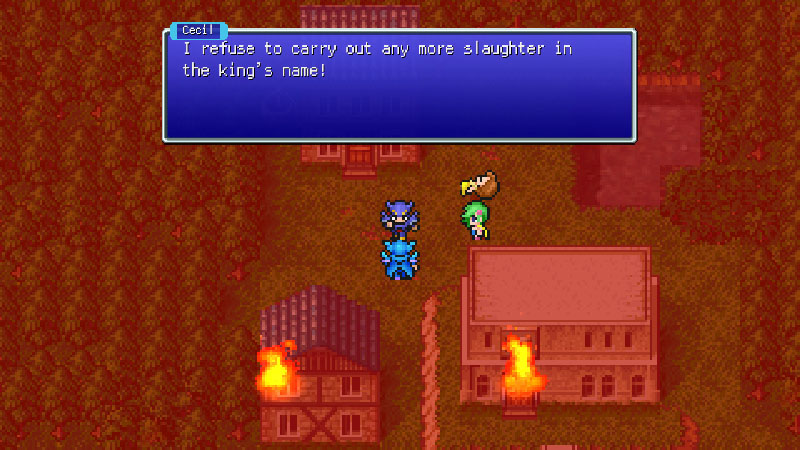
Meanwhile, game director Hironobu Sakaguchi was struggling to get Shonen Jump‘s support marketing the game. An executive named Kazuhiko Torishima had strong criticisms of Final Fantasy’s shallow narrative, and made these feelings clear to Sakaguchi, who felt that games should stand on their gameplay. Despite initially opposing Torishima’s opinions, Sakaguchi eventually decided to take Final Fantasy IV in a more story-driven direction. In contrast to FF3, where it often felt like the player was controlling four characters that blended into one during story sequences, FF4 was designed to take after FF2 where individual characters had unique voices.
Those unique characters are ultimately the reason for the step back in mechanics. Final Fantasy IV features twelve party members; including a job system would require an unprecedented amount of unique sprites and animations. While this is a feat that would be accomplished later in Final Fantasy V, we should remember that this was at the very beginning of the Super Famicom lifecycle and the developers were learning it for the first time with this project.
In any case, the absence of a job system allowed for the inclusion of more unique abilities for each party member. While some jobs in FF3 had specialized battle actions like “Jump” or “Steal”, mages were relegated to expressing themselves with what spells they could cast. That changed in Final Fantasy IV, where the white mage Rosa could also “Pray” and the elderly black mage Tellah could “Recall”.
Ultimately, the game had a somewhat rocky launch with an immediate “Revision A” being published after a game-breaking bug was discovered. At launch, the game was criticized for “trying to do too many things at once” between its new battle system, the amount of special effects, and the upgraded soundtrack. This review is particularly interesting from a modern perspective, where it feels like Final Fantasy IV isn’t doing much of anything — which is why it’s important to keep a historical perspective in mind. The game was re-released and ported at least twelve times:
- Final Fantasy IV
- Final Fantasy IV Revision A
- Final Fantasy IV Easy Type
- Final Fantasy II (SNES version)
- Final Fantasy IV (Playstation version)
- Final Fantasy IV (WonderSwan Color version)
- Final Fantasy IV Advance (Game Boy Advance version)
- Final Fantasy IV 3D Remake (Nintendo DS version)
- Final Fantasy IV (Mobile phone version)
- Final Fantasy IV: The Complete Collection (PSP version)
- Final Fantasy IV 3D Remake (iOS, Android, Steam version)
- Final Fantasy IV Pixel Remaster
These ports are notable because each one made substantial changes to the game, like an artist that couldn’t quite put down the paintbrush. Many of them have extra dungeons, and some of them have extra narrative content. During development of the game, the original script was cut down by roughly 70% due to size constraints. Much of the cut content was supplemental exposition and dialogue, and the original main designer (now executive producer) Takashi Tokita sought to restore this in the 3D remake where possible. The 3D remake version also includes an “augment” system which allows you to actually customize the party members.
It is important to understand how radically different the versions of Final Fantasy IV are because my experiences with the game are equally different from someone who played it on the SNES or the DS. I played the Pixel Remaster version because I am most interested in the cultural artifact that inspired future Final Fantasy games and Japanese media. I am not certain I would recommend it as the “best” (most fun) version to play.
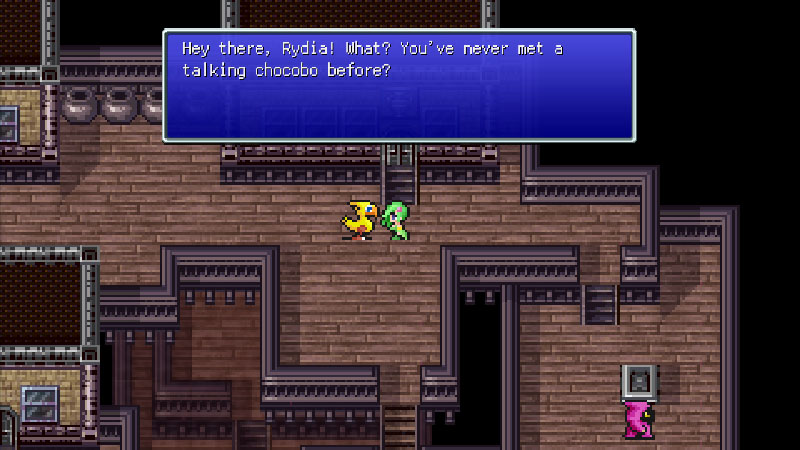
the fat chocobo in the room
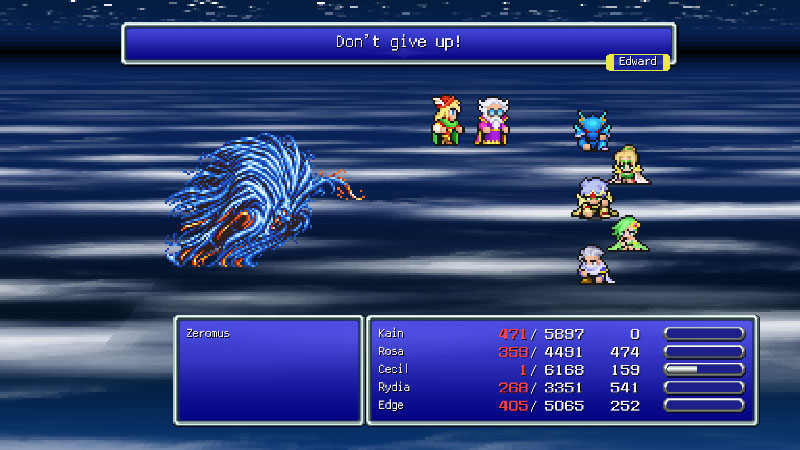
The singular mechanical advancement that Final Fantasy IV brought to the table was the introduction of the Active Time Battle system, which became a staple of the franchise until Final Fantasy X. The way it works is as follows:
Each party member has an “ATB gauge” that fills up over time. When the gauge is full, that character can act. Some spells and abilities like Jump have an additional wait time even after the gauge is full. After the action has been completed, the gauge is emptied and begins to fill again. During this process, enemies are attacking you based on their own unseen gauges.
You can think of the ATB system as a type of dynamic initiative system. ATB initiative operates on a per-character basis (rather than side-based) and consists of atomic turns rather than phases. “Shot Clock” or “Tick-based Initiative” is a similar concept that has been used in games such as Exalted 2E, Hackmaster 5E, Aces & Eights, and sometimes Shadowrun. While an ATB-style initiative has been blogged about in the past, I don’t know of any game that uses this specific style of dynamic initiative. That said, here is how I would implement it in a tabletop game:
Each combat participant has a track representing the ATB gauge, subdivided based on that participant’s speed stat. An average character might have a 10-step track, while an agile character might have 8 steps. The position on the gauge is tracked by a d6. During combat, the group counts ticks together, slowly moving the d6 up the track. When the d6 reaches the end of the track, that participant takes their turn. Each action has an associated “wait time”; if we follow the mechanics of FF4, attacks will be instant while offensive spells might take a few ticks. This is represented by the d6. For example, if I cast the spell “Firaga”, it has a 3-tick cost. I set my d6 so that the “3” side is facing up. Then, when tick-counting resumes, I must tick down my d6 until it shows “1” before the spell goes off and my d6 is reset to the beginning of the gauge.
Unlike other theoretical implementations of an ATB initiative, this version is deliberately deterministic. There is no randomness involved, as I feel it is truer to the video game’s mechanics. This has the added benefit of streamlining combat encounters. Once the table knows everyone’s Turn 1 speed, they can skip the empty ticks and simply start with the fastest acting character. Notably, a key feature of the ATB system (both in the video game and on a tabletop) is that participants can elect to wait until the perfect moment to take action. This allows for all sorts of tactical synergy and interesting encounters with enemies presenting limited windows for damage.
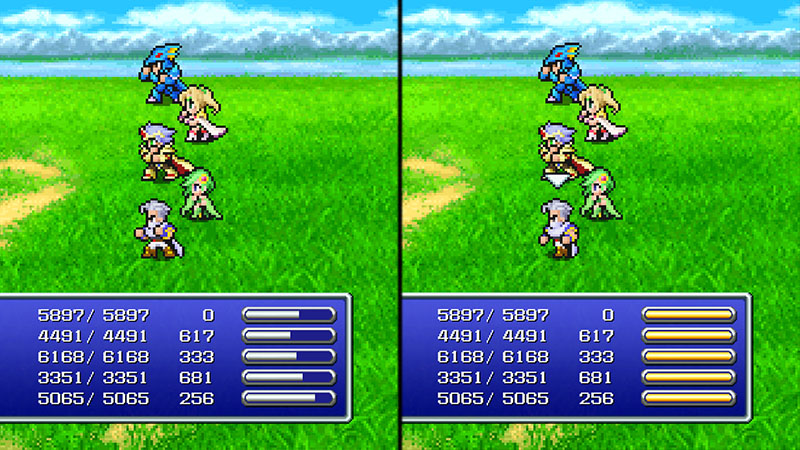
The Active Time Battle system was developed by Hiroyuki Ito, who felt that the future of roleplaying was real time combat. Despite this, Square wanted to remain faithful to the series’ mechanical identity, so Ito created the ATB as a compromise.
Ito developed the turn-based battle system used in Final Fantasy 1-3 based on inspiration from American football. The games were structured around giving a series of commands and then seeing how that “play” resolved simultaneously with the opposition’s “play”. When creating the ATB system, Ito turned to a different sport: Formula 1 racing. At the time, racers were changing from manual transmission to automatic; there were some who thought that this would reduce the thrill of driving by removing control from the drivers. Instead, automatic transmission allowed the drivers to focus elsewhere. By removing the player’s ability to control an entire round, they are forced to focus on individual turns and the specific timing of those actions. As an added benefit, fast characters were now able to act more often, creating a truer representation of speed than in previous titles.
I didn’t particularly enjoy my time with Final Fantasy IV outside of my academic appreciation for it as a piece of culture. Historically, the game has sold poorly relative to other Final Fantasy titles. In Japan, it is frequently overshadowed by Final Fantasy 3 and 5.
Despite this, it is undeniable that Final Fantasy IV is a landmark in the history of Japanese roleplaying. The characters had more depth than ever before, and the plot had a richness unseen in other games. The ATB system was rough around the edges, but elegant enough that it would be used in five more mainline entries and countless other franchises. This was the dawn of Square’s 16-bit era, and they would only grow more skilled over time.