The in-progress second bestiary for Fabula Ultima features a new type of conflict framework called “environments”. These are situations that must be overcome by the players, and essentially function as a collection of the preexisting mechanics from the core rulebook packaged in a neat bundle. At the core of an environment is a Clock representing the players’ progress. The primary method of filling that clock is using the Objective action on your turn: you describe how you affect the narrative; the GM calls for a roll, and you tick the clock based on how well you did.
Environments have sub-types like “battle”, “exploration”, or “social”, but they are always conflict scenes. This means that they are a series of back-and-forth exchanges at a rapid pace. Everything is “zoomed in” on the action and slowed down to initiative order.
Example environments include:
- Royal Court (Social)
- The heroes must persuade some kind of authority to follow a specific course of action.
- Misty Forest (Exploration)
- The heroes have been magically separated from each other and must reunite to confront a threat.
- Corporate Facility (Exploration)
- The heroes must infiltrate a building and reach an objective inside.
- Hunting Dragon (Exploration)
- The heroes must reach a location while being hunted down by a powerful enemy.
- Poisonous Swamp (Exploration or Battle)
- The heroes must cross an area filled with poison or toxic substances in order to reach a location.
- The heroes are engaged in a battle with an enemy while dealing with environmental hazards.
- Gunfight Alley (Battle)
- All participants are either hidden or exposed and only exposed participants can see each other. Enemies might have special abilities that change a creature’s state.
For those interested in the details, I encourage you to join the Fabula Ultima discord — all of this information originates from the extremely generous work-in-progress screenshots by Ema.
environments in play
This week my players were going fishing and I knew I wanted to do something beyond a simple fight, so I thought I’d give environments a shot after reading through them. This is not the first time I’ve attempted to run a dungeon in Fabula Ultima. My first dungeon used Flux Space, but it had way too many random encounter battles. Then I tried something completely freeform with trash mobs acting as hazards, but it was difficult to communicate that threat without making it seem like those enemies should be a full battle. Most recently, I felt really inspired to recreate the FFXII Garamsythe Waterway dungeon on grid paper, and we had fun doing some mapping exploration with it. The natural loading screens of FFXII break the dungeon into chunks where it made sense to call for a travel roll, and that helped communicate the presence of danger during exploration.
For our fishing excursion, I created the Sea Cave environment modeled after the Corporate Facility example. The main reason I chose it was because it represents exploring a dangerous location and it had a mechanic for confronting a champion-rank enemy. This environment replaces all enemies in the conflict, and has a 10-step clock called “Reach the Lair”.
- When sections 2, 5, or 8 are filled for the first time: two razorfish join the scene and can act immediately during this round.
- When sections 3, 6, or 9 are filled for the first time: the party finds something useful:
- Pirate Sword
- Smuggler’s supplies (5 IP for each player)
- <a clue relating to a pair of villains they have yet to meet>
If two or more of the above sections are filled during the same turn, all of the corresponding elements are added at the same time.
There is also a 6-step clock called “Bait the Water”. This clock fills 1 section at the end of each round where one or more undefeated enemies are present on the scene. It also fills 1 section when an enemy is defeated.
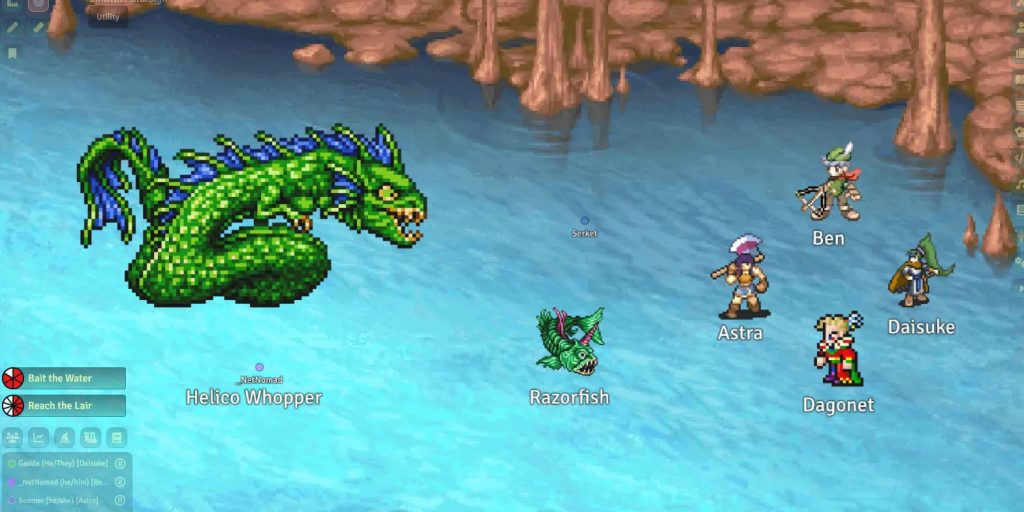
If the players fill the main clock, they make it to the lair of their target (the Helico Whopper). If the bait clock fills, the Whopper is attracted to them by the presence of the smaller fish. Either way, the smaller fish leave the scene when the battle with the Whopper begins, and the players have a chance to heal in-between. While the example environment had a similar setup with an infiltration clock and an “alert” clock, the framing is slightly different: it’s possible (and encouraged) to overcome the Corporate Facility without attracting the attention of the champion fight. For us, the entire reason of the quest is to find and slay the monster fish.
Despite this, I like the fact that there were two clocks, because the bait clock functioned as a failsafe — if the players focused on fighting every razorfish instead of running through the sea caves, it meant that there was a maximum amount of time we could spend fighting the trash mobs. On the other hand, we never got to see what was in the Whopper’s lair since it came out to meet us. I didn’t have anything specific planned ahead of time, but I imagined a miniature dragon’s hoard.
As part of my prep ahead of time, I sketched out a list of 10 sub-obstacles to be addressed. Technically, you would only need 9 to reach the end of the cave, and it’s easily possible for players to fill multiple clock sections in a single action. This is what I had written:
- Giant hole
- Submerged passageway
- Branching tunnels
- Sharp coal
- One hundred crabs
- Total darkness
- Ravine
- Siren
- Will o Wisps
- Dead end
what i would do differently
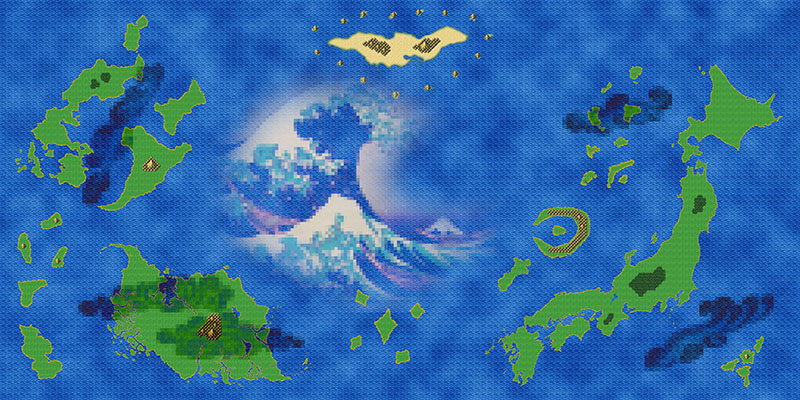
To be perfectly honest, I spent most of my prep time this week building a giant world map. Everything for the actual session was put together the night before with limited sleep.
One of the big things I’d like to have done is spend more than 5 minutes coming up with those sub-obstacles. I think there’s a lot of potential to link them together into something with a little more narrative. I also think that having them written out will help me communicate the situation a little better.
What I found is that the sub-obstacles were less “sticky” in the minds of the players, especially compared to the razorfish appearing. Even though I had a 10-step clock on the side of the screen, it’s small and out of the way — easy to forget. I think having a larger “tracker” graphic to communicate the exploration progress would have helped keep some focus. Ideally that graphic would help represent the individual challenges, or maybe secondary graphics would be useful, though asset hunting is often the hardest part of my prep.
It was difficult to know how well the environment would pace. With a 10-step clock, I could easily see all of the players getting lucky and filling 2 ticks per turn, burning through the clock in two rounds. If one of them got a crit, they could even fill the whole thing in one round. Right now they’re all level 5 with only one ability that interacts with clocks, but they could potentially move even faster in the future. For this session, they took about five rounds before the Whopper showed up while they were fighting razorfish.
Speaking of the trash mobs, I built them using the standard soldier-level assembly method outlined in the bestiary. This is what the example environment recommends for the encounters: a number of soldier-rank enemies equal to half the number of player characters. Even though the players have the ability to “bypass” the random encounters and stay focused on the objective, I would lower the max health of the soldier enemies in future dungeons. I want them to be dangerous and a drain on the party’s resources, but I don’t really want the players to have to spend multiple rounds to eliminate them. I would much rather them have a lower health total and be able to throw more of them at the players to really get the feeling of fighting your way through waves of monsters.
Of course, not every environment is going to be a dungeon like this.
Overall, the session was an incredible success and we had a lot of fun. Our clown chef assembled “the Ultimate Meal That Kills You” and loaded the Whopper up with status effects and lightning damage. The no-nonsense ronin got hit with an attack that dropped him to 1 hp before retaliating with a counterattack. Our gladiator princess valiantly went down in the last round, leaving the plucky explorer to deal the killing blow with an elemental shard. We cooked the fish into a massive feast for the local village and were rewarded with a repaired airship and a new fishing minigame.
I can’t wait to see what happens next.
1 Comment
Hi Serket. I’ve stumbled upon your blog about a month ago. I love it. You offer something very different from the usual osr crowd I follow. I find it quite refreshing. Plus I have (suffer from?) nostalgia with the kind of console games you often reference to. I also think anime and manga can be great sources of inspiration. Fabula Ultima looks like a lot of fun.
David Skelector