The first one, I mean.
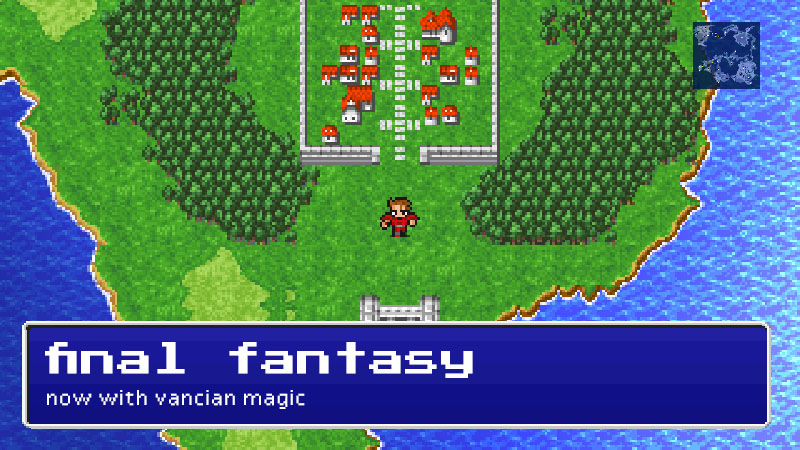
If you’re new here, this is the third post in a series where I talk about video games from a ttrpg perspective. Video games are one of my major inspirations as a GM and ttrpg designer, so I like to think about how I would translate digital mechanics to the table top. After spending several months working my way through Final Fantasy XII, I decided I needed a change of pace and cracked open the Pixel Remasters. These are the first six Final Fantasy games with some visual upgrades and quality of life features, and I’ve been meaning to familiarize myself with the foundation of the franchise.
Unlike FFXII, the first Final Fantasy is extremely straightforward. There are few game mechanics with enough depth to do a deep dive on. Part of the reason for that is because the game is already similar to classic Dungeons & Dragons. I was shocked when I learned that mages have per-day spell slots divided into various levels. Most of my notes are about the ways the game diverges from traditional D&D, and I suspect those few exceptions will make for a much shorter post.
baseline understanding
You play as the four Warriors of Light, prophesied heroes who have appeared out of nowhere when the world needed them most. You have four elemental crystals and journey across the land restoring balance to the elemental forces that have been usurped by elemental fiends.
At the very beginning of the game, you choose who is in your party. You have six options, which may be combined in any way desired — including repeats:
- Warrior
- Monk
- Thief
- White Mage
- Black Mage
- Red Mage
You can name each party member whatever you wish, but the game will not treat them with any individuality. The only significance to a character is their abilities in battle. Warriors can use heavy weapons and heavy armor. Black Mages can cast damage spells.
That’s mostly everything. The core concept of the game is about traveling across a world and having combat. There are a couple of “””side quests””” but they boil down to retrieving a key item (usually in a dungeon) and bringing it to an NPC who will reward you with new abilities or a weapon.
accuracy and roll to hit
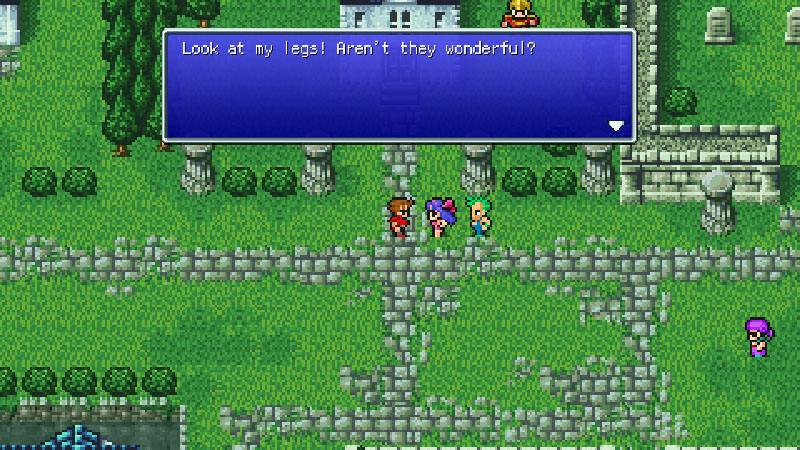
This game technically has roll to hit mechanics, but I don’t ever remember seeing any of my characters miss an attack. On the other hand, enemies miss quite frequently based on the PC’s evasion stat. This asymmetrical design is something I haven’t seen proposed for ttrpgs: player characters roll damage and enemies roll to hit. Rather than have enemies roll twice as much, this mechanic pairs beautifully with static values for damage (something I was a fan of in Sword World).
Final Fantasy characters do have an accuracy stat, but the biggest impact it has is in determining number of attacks. Every 32 points in accuracy grants an extra attack in battle, up to a maximum of 8 hits under normal circumstances. The Haste spell doubles your hits, and Monks always deal twice as many hits as their accuracy would otherwise indicate.
No matter how you slice it, that’s a lot of math to do at the table. Even if you are simply rolling for damage, it multiplies the amount of stuff to keep track of. That said, I really like the dynamic it offers for weapon design: there’s a choice to be made between big damage and multiple instances of smaller damage. It also feels more appropriate that Fighters can keep up with Wizards by rolling more attacks to keep up with bigger spells.
evasion and defense
As I mentioned earlier, the evasion stat grants a party member the chance to be missed by an enemy attack. Evasion is directly reduced by weight — equipping heavier armor means you are worse at dodging. However, heavy armor increases your defense, which acts as flat damage reduction for all physical attacks.
These two stats create two archetypes for survival: the high defense heavy armor approach or the evasion-based “dodge tank”. This is reflected in the spells available to the party; white mages can cast Protect to increase ally defense or Invis to increase ally evasion. While the game does have a Magic Defense stat, it is hidden from the player and exclusively affected by class and level.
The most interesting thing about receiving damage actually happens before the defense calculations.
In battle, party members are arranged in a roughly vertical line. The character in the top position is targeted 50% of the time, while the second is targeted 25% and the third and fourth are attacked 12.5% each. This creates a natural way to represent tanking without having all-or-nothing aggro mechanics. I have long desired a way to recreate the fantasy of a classic RPG party, but most tank mechanics are too rigid for me. Either you perform them correctly and enemies are forced to attack you or you let your party down. This is a nice middle ground where you take the brunt of attacks but there is still the danger that one might slip past your guard.
Fabula Ultima uses random targeting (most of the time) and I’ve grown to enjoy the surprise, but I think weighted probabilities are a really elegant addition. To that end, I created an accessory for one of my players that increases the chance of a random attack targeting them: instead of rolling 1d3 for my three players, I roll 1d4 and two of the numbers are assigned to the wearer.
initiative and ambushes
The final point of interest for me is Final Fantasy’s initiative system. They don’t call it that, but their method for handling turn order surprised me a little.
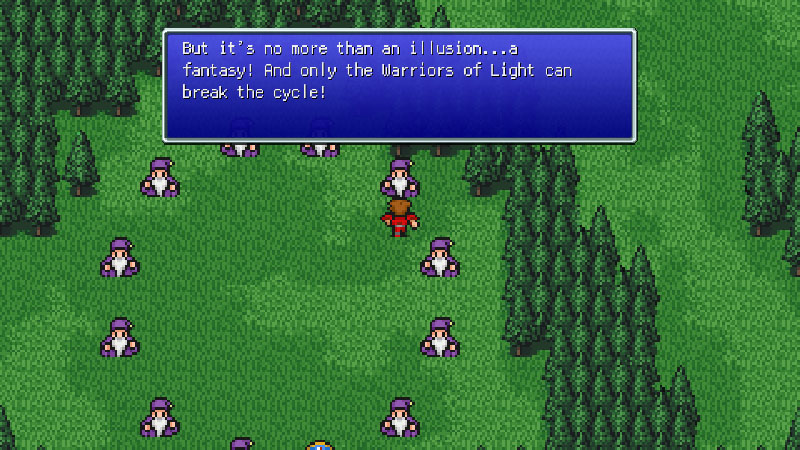
In general, you select an action for each party member to take. Then, the entire round plays out in a random* order, with no control over the sequencing of your actions. In the NES days, this could mean that if an enemy was defeated before another character could attack them, they would swing at empty space. Thankfully, the Pixel Remaster simply has the attack target another enemy. However, there is no way to force your attackers to wait until after a buff has been applied to them, leading to some frustrations in boss battles.
The turn order is influenced by the combatants’ Agility score, which is added to a random number from 0 to 49, and then executed from highest to lowest. Because this stat cannot be modified in battle, there is no way to force the turn order into an advantageous configuration.
Occasionally, the beginning of the battle will start with either a pre-emptive strike or an ambush. The former indicates that all player characters will take action before the battle begins, and the latter is the opposite — all enemies will go before a normal round starts. While the wiki lacks definitive information on the mechanics, I found an old GameFAQ post from 19 years ago which explains that the hacking community found the formula used. The party leader’s agility and luck, divided by 8, is used in a random formula and added to itself and reduced by the enemy’s “surprise factor” to create a number. If that number is less than 10, the party is ambushed. If the number is greater than or equal to 90, they get a pre-emptive strike. Otherwise, the battle proceeds as normal.
I don’t much care for random turn order, but I do think that having outer bounds for initiative is an interesting design space, depending on how swing-y your combat is. For games where it would be too much to let an entire side take a full set of turns, I would represent this mechanically by giving one side a bonus or allowing them to do “set up” actions. Alternatively, electing one member from a side to have a pre-battle turn would most likely be fine.

Final Fantasy is a foundational game, but it is also extremely simple. These few quirks of its combat system were the most interesting mechanics in the game, and I’m looking forward to seeing how other titles diverge from this standard. Next up: Final Fantasy II.
1 Comment
i love that you pointed out the spell slots thing — i never realized ffxiii was basically just doing d&d’s system but nobody talks about it that way