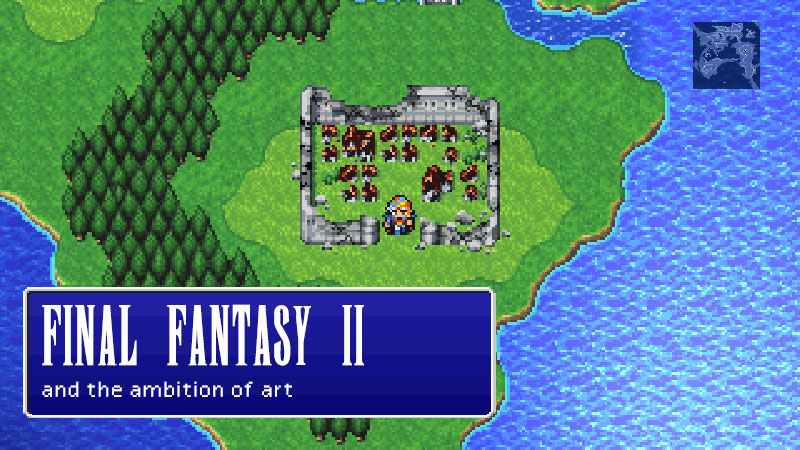
Final Fantasy II could have been a ttrpg…but it probably would have been even more controversial than its video game counterpart. Despite having relatively limited exposure to the Final Fantasy community outside of FFXIV, I am well aware that Final Fantasy II is one of the more unpopular entries in the series. Many creators openly loathe the game, and even my more academic guidebook admits that the mechanics are “unusual” and “awkward”. When I played the game, I went back and forth on how I felt about it. I wasn’t sure whether I liked it or not, but by the end I could feel it burning in my heart the way that Final Fantasy XII does. The story and characters are part of that fire, but I think the mechanical quirks reveal the passion and wonder of the developers: this game is a swing for the fences and that resonates with me.
double everything
That’s what it feels like to play this game. More dungeons, more dialogue, more weapons, more story. It’s an overwhelming experience coming from the blank slate first game to being dropped into the rich story of rebellion with Firion, Maria, Guy, and Leon. You have the option to name your characters if you desire, but they have canonical names and a backstory now. The player characters are four orphans on the run from the Palamecian empire, and your primary motivation is the destruction of that empire.
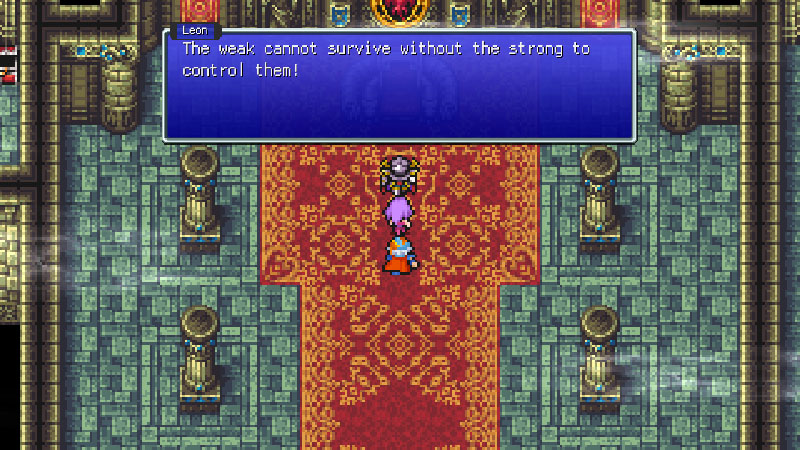
Even beyond the player’s party, all characters in this game are written like people. Rather than static signboards that exist to inform the player where the next dungeon is, they have personalities and often act on their own accord. Final Fantasy II is a game with a story to tell — and it succeeds.
linear plot, open world
In the first game, your objectives (and the plot) stayed fairly loose: restore the crystals to grace. On paper, you could do this in any order. In practice, you were extremely limited in where you could go and what you could do. Most areas of the map were locked by terrain features which could only be overcome through key items in a specific sequence. You save a princess to build a bridge to go to the town where you can get a boat which lets you get a mystic key to unlock the vault with nitro powder and blow open a canal. I could go on.
In contrast, Final Fantasy II is wide open. You can walk anywhere on the map as almost every location is connected by a giant landmass with few natural barriers between them. Instead, you are strongly encouraged to cease exploration by high level encounters when you venture too far in the wrong direction. The game has an expected route for you to take, but it will not stop you from exploring as long as you’re strong enough.
The frustration arises from the fact that there is no pretense of self-determination when it comes to the events of the story: you must first go find mythril for the princess then destroy the dreadnought then go find sunfire. It goes on like this, with one event happening after the last until you reach the end of the game. There is no option for you to achieve these objectives out of order, and there is no pretense that you will do anything except react to events as they unfold. Unlike the first game, your quest rarely requires you to explore the world, as the princess often sends you on missions to specific locations.
Despite the linear structure, I still found the world of Final Fantasy II much more engaging than its predecessor. This is my personal bias as a player and a GM, but I would much rather be in a game with stuff happening than dropped in an open sandbox with vague ideas about saving the world. Final Fantasy II feels like someone taking the first step into a more dynamic setting, and if we look at the later works of Akitoshi Kawazu (one of the main designers) we can see further steps into non-linear storytelling in his SaGa series. On the other hand, the NPCs of Final Fantasy I and III seem content to wait around until the destined heroes show up to do anything at all.
This is why I am a fan of faction moves and GM cutscenes in ttrpgs. The world should feel like it’s moving without player interaction, and the players should be aware of it even if their characters aren’t.
characters without classes
I’ve danced around it for long enough. Let’s talk about mechanics.
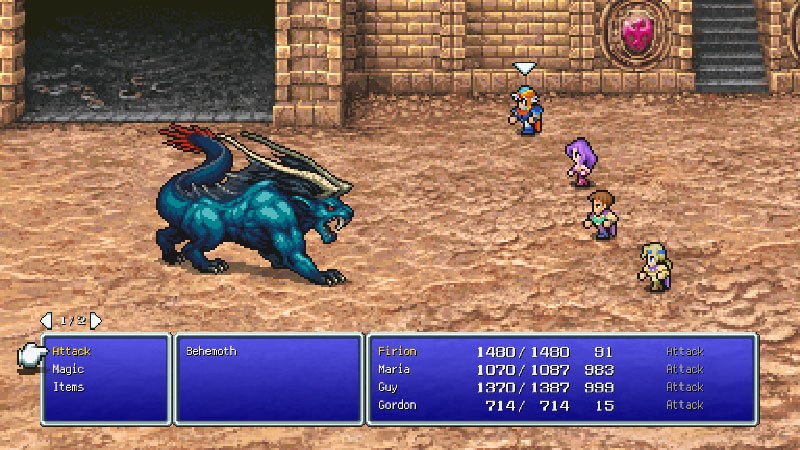
Characters in Final Fantasy II do not have classes or jobs or roles which define their abilities. Every character can equip every piece of armor or weapon and learn any spell. Moreover, there are no levels for characters; each weapon and spell has their own level from 1 to 16. Skills increase in level as you use them.
The consequences of such a system might not be immediately obvious. The first question might be: “What stops you from giving every character the best stuff?”. Nothing. Nothing except time and your own patience. It’s easy to say that skills increase when you use them, but the implementation of this mechanic is where the devil lives.
sidebar: leveling
Skills have a level from 1-16. Enemies have a rank from 1-7. In order to gain EXP in a skill, you must use that skill in a single battle a number of times equal to the average rank of the enemies minus the skill’s level. (Approximately). If you do not use the skill enough in a single battle, you gain no experience, and your uses do not “carry over” to the next battle.
For example, in order to gain experience for a level 4 skill, you must use it over four times in a battle with rank 1 enemies or over twice in a battle with rank 3 enemies.
First: this means that the optimal way to level skills is to have a single character use that ability repeatedly in battle and the other three party members stand around doing nothing. This makes battles take longer.
Second: battles can have a maximum of eight enemies. This means that when your sword attacks start killing enemies in one hit, you are only able to gain experience up to level eight — assuming you’re lucky enough to be able to reliably farm battles with eight enemies.
Third: none of this is obvious. The game does not tell you the requirements for leveling a skill or gaining experience. There are no numbers associated with the amount of experience you have in a skill, just a red bar that slowly fills up. It turns the whole game into a skinner box where sometimes your skills improve and other times they don’t, because you have no indication that the random encounter had a slightly higher average enemy rank unless you go to the bestiary and start looking.
Once you get annoyed enough at inconsistent rewards to go do some research, the system is fun for a glorious brief moment as you realize how easy it is to level. And then you realize you know exactly how much work it will take to level everything you want. And then if you do it, battles become binary: you’re either overpowered because of all of your hard work or underpowered because you are limited by the equipment you have access to. I recognize that these are my personal demons as an optimizer, but the game does not make it easy for you to know how much you should be leveling, because you won’t gain enough just incidentally playing the game.
I’m particularly proud of discovering that I could intentionally blind my party to have less accuracy as I was training my weapon skills against enemies. This wasn’t in any of the guides I read, and seems to be a fairly unique approach. The more heavy-handed alternative is to attack your own party, but that was a line too far for me. In spite of everything, I still cared about Firion, Maria, and Guy.
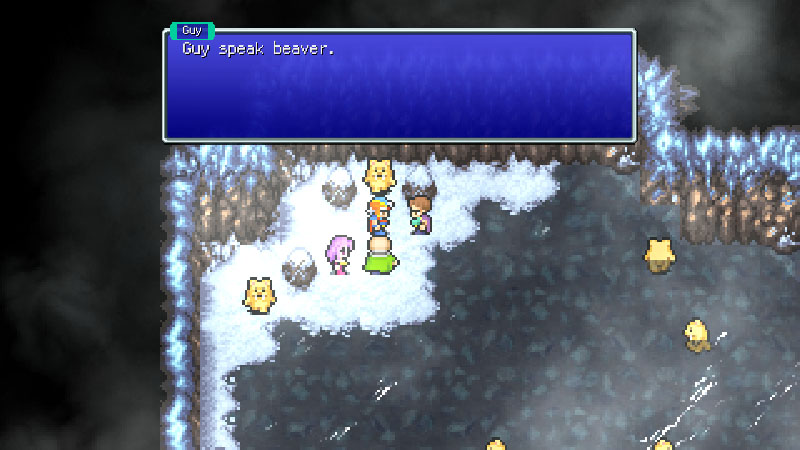
The way that Final Fantasy II incentivizes you to specialize is by linking stats to certain skills. Strength increases when you use weapons. Intellect increases when you use Black Magic spells. A character who has max swords and max Fire spell is going to be less effective at physical attacks than someone who has mastered multiple weapons, and less effective at magical attacks than someone who has mastered multiple spells.
Additionally, the game further separates skills by adding a Magic Interference stat to all armor and weapons. Knives and staves have low interference, so they naturally become caster weapons. Even if you’re not trying to recreate classes from the first game, the mechanics reward you for building something similar.
And yet.
It still felt special to me when I decided that Maria would be a frontline mage with two knives. I worked hard to give her a high evasion by making her use two shields for the first half of the game. I spent hours in the northern ice fields after discovering that I could train my Blizzard spell against monsters that absorbed ice damage. Suddenly she was more than a blank canvas of potential — she was Maria the Ice Mage and a deadly assassin. This is roleplaying to me. My Maria is nothing like the Maria in the concept art (an archer), but the game still cares about her and her relationship with her brother. In spite of the implementation, the beauty of Final Fantasy II’s battle mechanics allow me to feel like I can express myself and still matter.
the ambition of art
I mentioned Akitoshi Kawazu in passing earlier, but it would be a disservice to undersell his ambition for Final Fantasy II. After the release of the original game, Hironobu Sakaguchi (the creator) did not have a strong vision for a sequel, and sought input from his team. It was Kawazu who stepped forward with a bold new direction for the next game, one that would focus on the evolution of its characters rather than ones with a static nature. He wrote the first draft of the game’s plot, envisioning a complex story with multiple factions and branching narrative leading to different endings and a morality system that affected NPC interactions. While this vision ultimately had to be tempered by the limitations of the Famicom, I believe that the core of the game still reflects that dream, and that Kawazu’s design reflects his noted love for tabletop games.
Translating Final Fantasy II to the tabletop would be difficult, but the core concepts are reflected in many popular systems. Fabula Ultima has classes, but they function as skill groupings and each character is a composite of those skills, which have their own ranks. The key difference from FFII is that players have a clear understanding of when they will gain new levels and full control over what skills to put more points into. Fabula also has artificial limitations on the amount of un-mastered classes, which forces players to commit to a handful of playstyles rather than cherry picking the best skills.
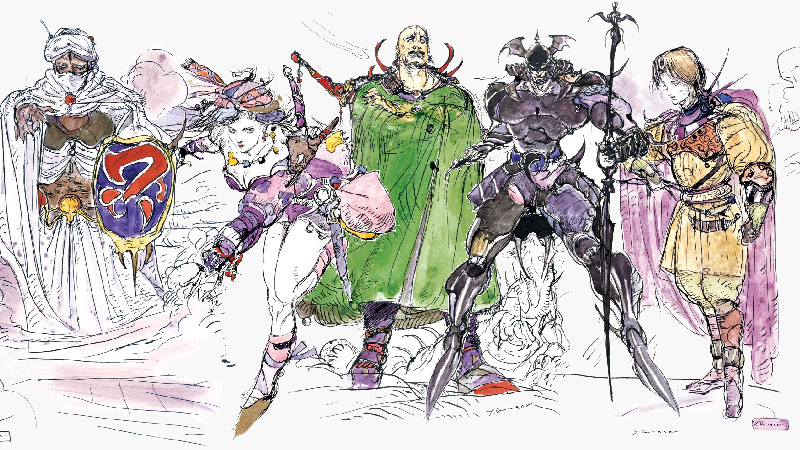
I think the most important takeaway from Final Fantasy II is the way that different interpretations of player agency can drastically alter a game. Players are locked into a set story that proceeds in a linear fashion, but have the freedom to express their characters and personalize that story. In comparison, Final Fantasy I is a non-linear game with little room to make the experience unique. I believe we can design beyond these two extremes, but between the two of them, I definitely prefer Final Fantasy II and I’m glad its developers had the courage to try something new.
3 Comments
Thank you for doing this series! It’s been a delight to read.
If you haven’t already, it’s worth dipping into the first couple SaGa games to see how Kawazu and his teams continue to play with this more abstract approach to advancement in RPGs. There’s ideas in those first couple games that I continue to tinker with effectively implementing into tabletop dungeon games to this day. The first game in-particular goes pretty quick, being designed with the idea that someone could play the entirety of it in the span of a single intercontinental flight.
FF Legends and SaGa are definitely on my list, though my plan for the immediate future is to continue through the mainline Final Fantasy games.
yeah i appreciate this take on ff2—the “swing for the fences” thing really stuck with me, especially thinking about how those weird mechanics actually do feel like devs just trying something different instead of polishing the familiar formula.