In 2025, I wrote a post called “alternative game fantasy: a manifesto“. It was my best attempt at expressing dissatisfaction with the six cultures of play, specifically because I feel left out of the cultures described. Since then, I have written many more posts, played and reviewed many more games, and had a singularly enlightening conversation with Dwiz of Knight at the Opera. I had always planned on writing a new edition of the manifesto, but until that discussion, I didn’t have a solution to the taxonomy gap I was struggling with.
alternative game fantasy
My original manifesto had four main tenets:
- death is a status effect
- anti-random
- the answer is on your character sheet
- rules maximalist
These were written almost as a direct opposition to popular OSR maxims, which composed most of the theory I had been reading at the time. Frankly, the OSR still dominates the blogosphere in terms of theory, but it’s clear some of these lack substance as a standalone philosophy.
“Death is a status effect“
Treating death as a temporary condition is addressing a symptom rather than a root cause. Treating combat as sport rather than war naturally leads to lower stakes for losing that combat. Furthermore, the more complicated (rules maximalist) a system is, more decisions are required to create a new character. This makes it far more painful to permanently lose a character that you have spent many hours carefully building — particularly if it happens before they really get the chance to show off all of the choices made during that process.
“Anti-random“
Randomness isn’t inherently bad. I think this tenet was originally against random encounters and their potential lethality, but in hindsight, I believe the more appropriate perspective on a cultural level is about being able to make decisions — agency. When you make a character, it is an expression of yourself and your personal vision. If the system robs you of the freedom to execute that vision by forcing you to roll random stats, it feels bad. Similarly for the GM, encounters (and everything else you build) is also an opportunity to express yourself creatively. The more a system allows you to do that without getting in the way, the better.
“The answer is on your character sheet“
You put the answer on your character sheet. The choices you make in character creation are the point. Playing the game is what allows us to see the consequences of those choices — tasting the meal after you’ve cooked it. I think character creation is an important highlight because it is the closest you get to playing with the system rather than the other players at the table.
“Rules maximalist“
The definition of a game is hotly contested, and I would never say that a game is only the rules. But I do think that the game gets bigger when you add more of them. I like playing games. I like “system mastery” the way people like to solve puzzles or play with a toy. The subsection of “fun” that arises from my time-displaced interaction with a game’s designer is just as important as what happens at the table between myself and the other players. This is why I think rules maximalist is a strong indicator for the types of games we’re concerned with today, but ultimately a culture is not rules maximalist.
culture vs. game
Let’s circle back to the six cultures.
Trad. OSR. These are terms that people misuse, because the original post was about cultures and not games. Despite the very specific warnings present in the post, people refer to (and market) systems as “trad games” or “OSR games”. Even people who acknowledge that this is a misapplication of the taxonomy, myself included, frequently slip into discussions about whether something is or isn’t a “storygame”.
Alternative Game Fantasy was influenced strongly by the OSR, which is why its tenets are expressed as system design rather than cultural tradition. This fact became more apparent over time, but it was highlighted in my aforementioned discussion with Dwiz. In my zeal to develop taxonomy, I had been ignoring the fact that a culture is made up of people — people who have been using these terms to refer to themselves as a community.
“Trad” has been used by trad players to refer to themselves since the 80’s. That’s in the original six cultures post, and it’s something that I glossed over multiple times. As much as I personally want to use the term in a more perfect taxonomy of games, I will never be able to out-logic the fact that this word refers to a specific group of people.
optimization
This is where Dwiz saves me from the dark. He described the existence of a lost seventh culture of play centered around “optimizing”. Multiple terms were proposed in the discussion thread: Tinkers, Red Mages, Mathfinders, but I enjoy the simplicity of just calling it Optimizer Culture. Before I unpack the connective tissue of what that culture bonds over, it’s important to understand what optimization means.
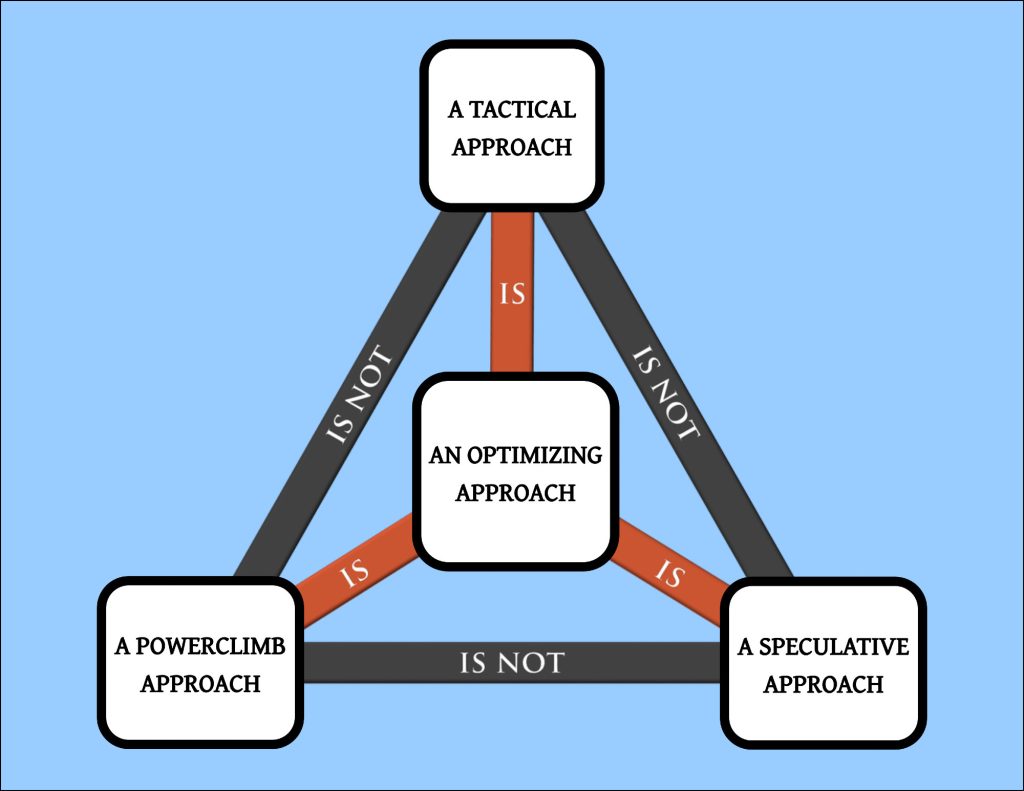
Levi Kornelsen posted this graph back in October 2025 and it has lived in my mind rent free. Here is his explanation of the terms:
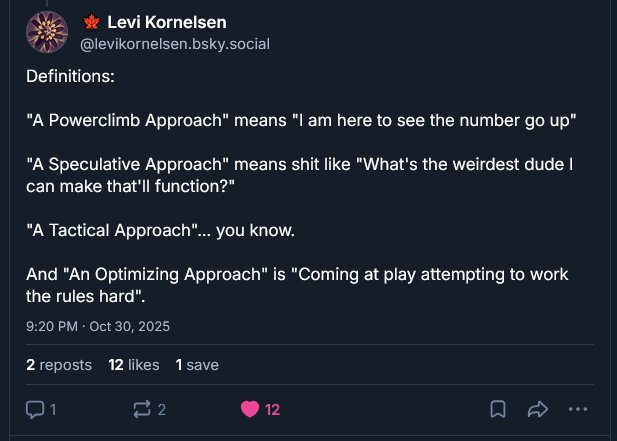
This is the cleanest explanation I’ve seen for the fact that optimization is not the same as hyper-competitive min-maxing. That is a stereotype, albeit, probably based on players who liked optimizing but didn’t know how to engage with it in a healthy manner.
“Can I make a viable build based on this non-combat prestige class?”
“What’s the maximum amount of damage I can do using only thrown weapons?”
“How do I best support the needs of my party at this level?”
These are the types of questions that optimizers are asking. They are out there talking to one another — making tier lists and posting build guides. Unlike the OC / Neotrad players, they are not content to absorb the rules through exposure to actual play podcasts or GM explanations. Levi summarizes it best: an optimizing approach is coming at play attempting to work the rules hard.
the optimizer manifesto
As I stated in my last manifesto, I am neither an academic, nor am I a historian: I do not have data that shows when optimizer culture “started” or if anyone actually thinks of themself as an optimizer. The examples I use are anecdotal and the existence of optimizer culture is aspirational to me. I don’t believe everyone should be an optimizer either; my goal is to make people aware that we exist and that optimization can be a healthy play experience.
play to work the rules hard
Optimization is about setting a goal and then using the rules to achieve it. That goal isn’t always competitive: you might be trying to make a character that knows every language, for example. The important thing is that the pursuit of this goal is represented mechanically, and the goal is often about testing the limits of the system.
play can happen when you’re not at the table
I’ve talked about character creation a lot, and for good reason. A non-trivial amount of optimizing fun is about making decisions well in advance of their relevance. It’s sort of like building a rocket, and then playing at the table is seeing how well it flies. The joy during the game comes from seeing how your expectations play out. This applies equally to optimizer GMs, who meticulously prepare encounters or balance tense political intrigues long before the players encounter them.
tactical finity
Tactical infinity is the concept that anything can happen in a ttrpg because the GM is able to make rulings on situations not covered by mechanics. When a system leans more on a GM to make those rulings rather than providing rules, optimizing means convincing your GM to let you achieve your goal. If they deny you, it can feel arbitrary and frustrating. If they allow you to do it, you’ll want to set a new goal even further (to find that limit). This tug-of-war feels bad for both players.
Optimization thrives when there are limits to find — tactical finity. When the system’s mechanics provide those limits, trying to reach them feels like climbing a mountain rather than an adversarial debate.
local maximums as much as global ones
In trading card games, a competitive player is someone who wants to use the best deck so they have the best chance of winning. An optimizer player is not interested in playing an already-solved problem. More often, they enjoy playing “rogue decks”: archetypes that aren’t considered viable on a competitive level. The fun is about trying to make those decks successful despite their disadvantages.
This holds true in ttrpg spaces: optimizer culture isn’t about being the best, it’s about working the rules hard to reach whatever local maximum you’re chasing.
The original Six Cultures post made it clear that these groups of people are not mutually exclusive with one another. There can certainly be overlap between optimizers and trad or neotrad, but that doesn’t mean they share the same values. It’s important to recognize optimizer culture as something separate and unique so we can meet expectations at the table. Understanding where other people are coming from makes the game better for everyone.
5 Comments
Thank you for speaking up for the gamish and rule-lovers among us 🙏
I appreciate you putting words to the feelings that many players have. I know I’m not one of these players anymore, but I once was and many of my players still are. This framework helps me understand how to better play into what makes the game fun for them.
I do have a… Disagreement sounds too strong, but it’s what I’ll go with. While I think games like D&D 5e are great for players to engage with the optimization culture, I don’t think many ttrpgs are built for GMs to engage the same way.
While a GM can run their games fully RAW in order to test the limits of a system, I think they will inevitably run up against situations where the rules are either unsatisfying, non existent, or just not quite right. Looking at Dungeontube, MANY people seem to be looking for 3rd party add-ons for various parts of the official 5e ruleset. This is a healthy part of the game, but doesn’t seem to lend towards finding joy in “working the rules hard”. I believe that the GM often finds limits in a game’s rules as something making the game harder for them to run rather than something exciting. Specifically referencing 5e I think of exploration, encumbrance, faction management, boss fights, and social encounters as things that GMs often look elsewhere to find better/other rules for. You’re telling the rules to take the rest of the day off because someone else could handle this part.
Further, I think the nature of most TRRPGs don’t allow the GM to play with engaging optimization. GMs DO have a tactical infinity at their table. Both before and during sessions GMs are always able to bend or break the rules. There are no limits on how a GM can create their encounters, stat blocks, settings, or anything else. There are suggestions, but things like CR are so comically unhelpful that I doubt anyone uses them for anything besides rough guesses as to whether a monster belongs in the 1-5, 6-10, 11-15, or 16+ range of party levels. I think this lack of structure off GMs can also take away of the optimization play outside of the table, but I think we all know that GMs get plenty of play outside of the table with their prep.
Further, the GMs cannot optimize towards viability in the same way that players do. For combat (which will no doubt make up most of the optimization goals), a GM can’t optimize towards winning like a player would. Instead, they must optimize towards the result of a well fought loss. However, you’re still playing the same wargame as your players. It feels bad when your monsters always miss. It feels bad when the boss you worked hard on building up falls flat because you made him too weak as to not overwhelm your players. The game isn’t set up for you to enjoyed losing anymore than it is for players to enjoy losing. There is a common desire in trading card games, especially MTG Commander, that if you’re going to lose, you want to at least see your deck do it’s gimmick before losing. I feel like this consolation prize is often the best GMs can get. You aren’t taking on voluntary restrictions so that you can persevere regardless, instead you’re voluntarily losing and hoping that you can hit the sweet spot of losing gracefully. I don’t think the play structure of D&D rewards that culture. I don’t think many games do.
Some random thoughts.
– Are there games that give GMs strict limits to how they prep out things like Monsters or Encounters?
– Do any games consider a reward structure/incentive for GMs to optimize in any way?
– How does homebrew play into the optimization culture?
– How does optimization culture look in games with lighter rule sets? What would a light/optimizable ruleset look like?
Again, thank you so much for your post. I don’t think you’re wrong, this has just been on my mind and your post really helped me but words to that feeling.
I think you are generally correct in your assessment of the ttrpg landscape. In particular, I don’t think 5e supports optimizer culture well — both for players and GMs. I also would agree that most ttrpgs are not designed for GM optimization. The two games that I enjoy (Fabula Ultima and Lancer) feel exceptional in this way, as both games encourage encounter design in ways rarely seen in other games.
In my opinion, the moment where you want an even playing field such that you are encouraged to win as much as your opposition, you should be playing a wargame. I think wargaming is great, but as a ttrpg GM, I enjoy optimizing “cool fights”. My fun is not diminished when the players win, and the best part of being a GM is that I get to try wildly different encounters every week. As a player, I’m stuck optimizing the same character gradually, but as the GM, I can experiment with different builds as much as I want.
death is a status effect
anti-random
the answer is on your character sheet
rules maximalist
You’ve just described a video game!
Yeah, the point about character creation feeling like wasted effort when you die before actually playing them really lands — that’s such a specific frustration that I never see discussed directly.