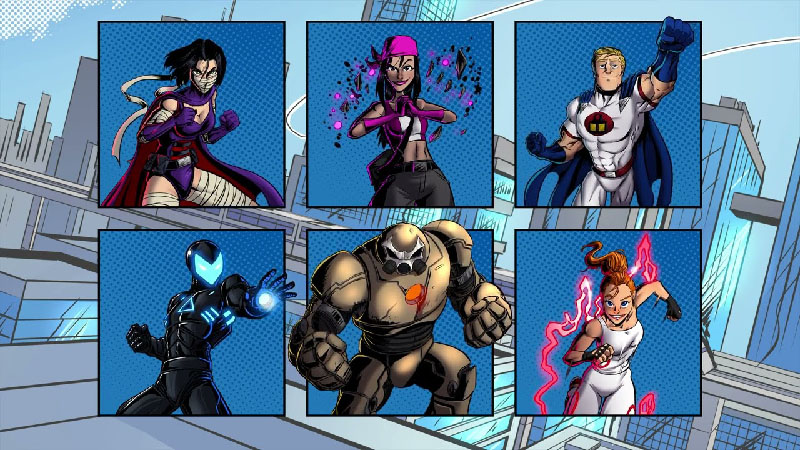
During college, I used to attend weekly board game nights with some friends. Sentinels of the Multiverse was a repeat favorite: a cooperative, fixed-deck card game. The game is easy enough to play while drunk, but it also has enough depth that a room full of nerds can sink their teeth into tactical optimization. Sentinel Comics: The Roleplaying Game falls short of inspiring the same fondness from me. While most of my objections arise from a difference in taste, I think the game has certain friction points on both the mechanical level and overall design philosophy.
To summarize, the game is played by assembling a dice pool to take one of five actions (attack, overcome, boost, hinder, or defend). Your character has a list of powers, qualities, and one of three statuses (green, yellow, red) and the dice pool is formed with one of each. My comrades from Paper Cult have already spilled ink explaining the basics and my friend Liz over at Magnolia Keep also has some helpful visuals from the book. I encourage anyone interested in a deep dive on the system to check those out; this post is more my personal feelings on the game and critiques having played it.
descriptive vs. prescriptive games
I started considering a new taxonomy in the wake of the first two sessions of Sentinels. A descriptive game is interpretive: based on the fiction, the players must reach consensus on which mechanics to invoke. A prescriptive game is one in which the book tells you what happens when you take specific actions in the fiction. Whether or not this dichotomy holds much water, I’ve been connecting aspects between games I dislike, and they usually involve a system where the optimal move is to argue for the application of advantageous mechanics.
Sentinel Comics, FATE, Legend in the Mist, even Apocalypse World — all of these are games where the optimal play is to force your +2 square peg into every single round hole through any justification you can manage. The alternative is to manipulate the story so that you only encounter square holes because that’s what your character is good at.
“The point of these games is to tell interesting stories. You can’t win Dungeons & Dragons.“
If the point is an interesting story then stop putting conflict resolution systems with success and failure in your game. As soon as you present a win condition, players are going to optimize for it. There are storytelling games without winning and losing — like Microscope or For the Queen.
The other alternative is to de-couple specific tactics from success and failure. A system can have success and failure as long as the mechanics you can invoke do not incentivize you solve the same problems in the same ways. Something like a metacurrency that you can spend when you want a roll to succeed. I’m not the first person to think of this — Rose over at Vorpal Coil has one of my favorite solutions.
Sentinel Comics treads the middle of the road between wanting to be a storygame where you play as custom heroes and a tightly-paced tactical board game. I love board games, but the two halves of this game force the player to choose between optimal play and better storytelling.
the initiative problem
Sentinel Comics uses Popcorn Initiative. As someone who wants to plan and strategize, I dislike this.
Let’s start with the biggest obstacle: you cannot let the GM take the last turn in a round unless you want every single adversary to have back-to-back turns at the start of the next round. This means you must constantly throw initiative to the GM to exhaust the pool of enemy turns rather than setting up any form of synergy between back-to-back hero turns. No fastball special; we have to respect the action economy.
Second: as soon as you toss initiative to the GM, you lose all ability to predict what is going to happen. They can force any hero to take a turn next (ruining any plans) or allow themselves to combo play. In a game where turn sequence is so vital, this is incredibly demoralizing. You can get forced to take a turn before the villain attacks and thus lose an amazing defense that you spent time setting up because it goes away on your turn.
On paper, this initiative method is supposed to reward teamwork and coordination because players have the freedom to choose who goes next. In practice, I felt like I couldn’t say anything out loud because as soon as I speak a plan into existence, the GM knows exactly how to throw a wrench into it by changing the order. By making turns so unreliable, it discourages me from planning at all. The action scenes were reduced to spinning plates and rushing to support whatever objective was most on fire when it came around to my turn.
Some readers might view this as a low trust stance to take. In a tactical game like Sentinels, I have fun because I trust that my GM is going to play hard and that the rules will balance the playing field. In a chess game, you expect your opponent to do everything in their power to win — but that doesn’t mean the table is low trust.
dead turns
Scenarios which require juggling multiple objectives are a perfect fit for a superhero game. Unfortunately, other mechanics conspire to make such situations feel bad as a player.
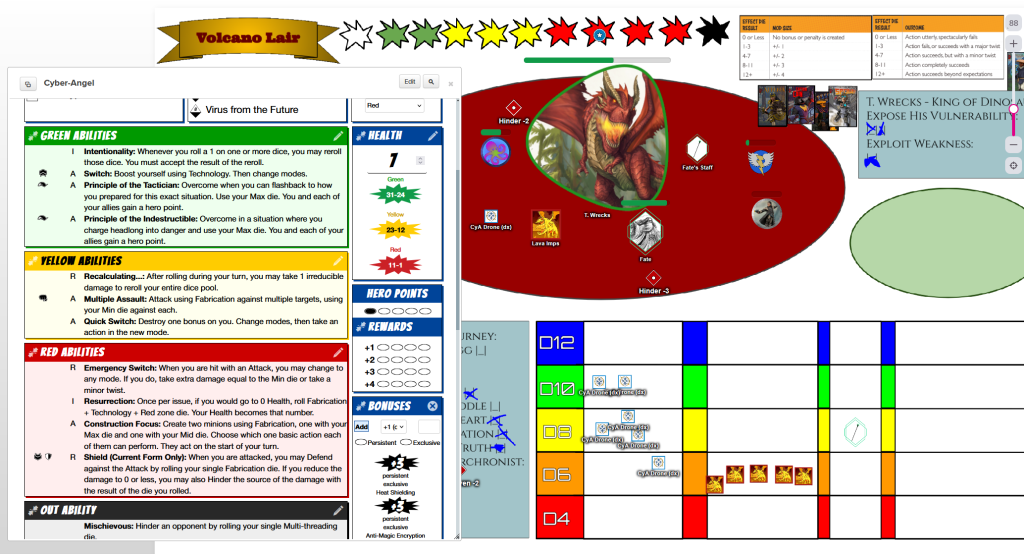
Movement in Sentinel Comics requires you to spend a full turn doing only that. While we used a houserule so that you could move and take a basic action, this still feels terrible as a player. Your abilities — non-basic actions — are the parts of your character that are unique and feel cool to invoke. In particular, my character Cyber-Angel used a form-changing archetype that allowed her to change stats and abilities based on her current form. Unfortunately, the only way to change forms was using an ability (and by default, changing forms takes an entire turn). Both of these problems compounded upon one another, making the evolving situations presented by our GM feel as though my character was two rounds behind everyone else.
It was extremely common for the game state to change, forcing players into dead turns with no control. While this was much more pronounced for my character, I noted other players lamenting the fact that they kept missing the chance to do a big multi-target attack because the villains had all left or that they could only defend other people but there was no one around them.
final thoughts
I don’t hate Sentinel Comics. I just think it lacks a cohesive design in certain areas.
This is a game that loves its roots as a cooperative board game. Unraveling the combat-puzzle-scenarios presented by the GM was incredibly fun, and I think the game shines with these tactical board game elements. The trouble arises from aspects of the game that feel like they exist because the designers wanted to add storygame elements. If Sentinel Comics used the same initiative system as Sentinels of the Multiverse (villain -> all players going clockwise -> environment), I would have been much happier. If movement was eliminated entirely or made a more prominent role in character abilities, it would eliminate a major pain point.
Of course, I also experienced downsides from this board game approach: the game rarely cared about what I was doing in the fiction beyond how that translated into numeric damage, boosts, or hindrances. I built a polybody distributed intelligence, but it never felt like I was truly everywhere because the game requires you to have a specific location. Finally, there is no advancement in Sentinel Comics. The character you make will never improve — they might change or perish — but they can never unlock new abilities or forms.
I’m glad I played Sentinel Comics, but I think I’ll keep looking for my perfect superhero ttrpg.
1 Comment
Absolutely terrible review. Your complaints are predicated on having an insanely hostile GW who does everything they possibly can to shaft the players at all times. That sort of person exists (although they can rarely keep their players for more than a session) but they’re a game-killer no matter what the system is. Sentinels is no more uniquely vulnerable to a “rocks fall, everyone dies” GM than any system, and you know as well as I do no one will put up with that nonsense for more than a session, if that.
Sentinels does have some real issues, but they mostly aren’t the ones you’ve cited. Most significantly, its advancement system is too fast to support long-term play as the GM winds up struggling to present an actual challenge pretty quickly. The action scene design system breaks down quickly when characters start accumulating 8+ collections, which is something that will happen in a year or so of weekly play. Despite your claims, characters do improve, and rather quickly, which the game system just isn’t built to handle past a certain point.