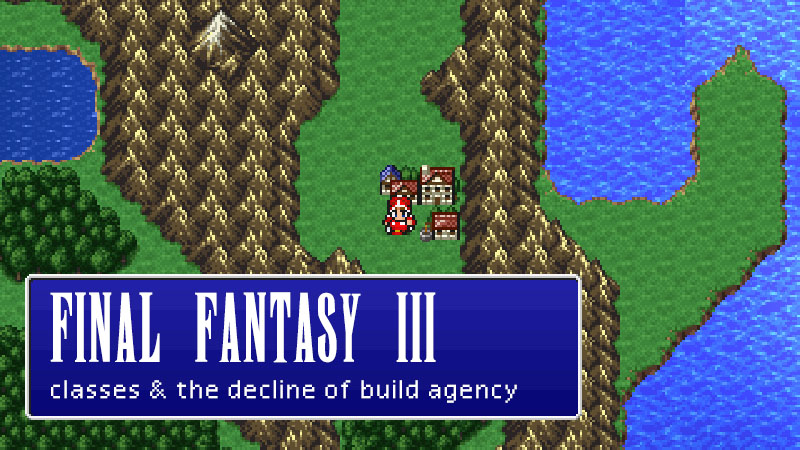
The third entry in the Final Fantasy series was a departure from the game design of Akitoshi Kawazu and a spiritual return to the first game. It’s a story about four prophesied heroes destined to restore light to elemental crystals and overcome the evil forces plaguing the lands. Only, there’s so much more of FF3 than FF1. We have 225 enemies in the bestiary instead of the 128 in the previous two games. We have a whopping 22 classes compared to the original six. The world itself is so much bigger with an entire floating continent to explore before you even get to the surface. In spite of this, I think the game is actually more forgiving than its direct predecessor: it feels like you can walk further before getting a random encounter, and the dungeons themselves are smaller with fewer monster closets.
All of this sounds great on paper. The problem that I have with Final Fantasy III is that the game is designed such that there is a correct choice for every situation. I’m getting ahead of myself though.
the job system
While the original Final Fantasy technically had a job system, you picked those jobs at the beginning of the game and they mostly operated the same. The main difference between them was simply what equipment and spells each one could access.
In Final Fantasy III, you have the ability to change your class at will, and progression through the story unlocks additional classes. Along with the different equipment and spells, classes also started to receive unique actions in battle: for example, dragoons can use the “jump” command, and thieves can “steal”. These custom actions go a long way towards making each character feel unique. Player characters have an overall level as well as a job level to represent proficiency with each class, and both of these combine to determine a character’s effectiveness in battle. The job level usually determines the effectiveness of a class and which abilities are unlocked from it, but the character level acts as a potency multiplier.
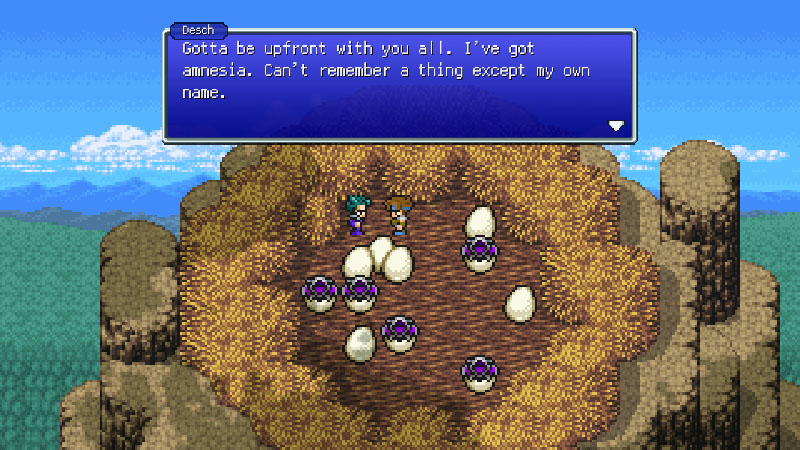
Let’s take a look at the job list:
- Onion Knight
- Warrior
- Monk
- Ranger
- Knight
- Thief
- Dragoon
- Viking
- Dark Knight
- Black Belt
- Ninja
- White Mage
- Black Mage
- Red Mage
- Scholar
- Geomancer
- Evoker
- Bard
- Devout
- Magus
- Summoner
- Sage
These sound great. Unfortunately, Final Fantasy III treats classes as one of two things: silver bullets or linear upgrades.
At several points in the game, progression is locked behind casting the “Mini” spell on your party to make you small enough to enter special dungeons. This not only makes having a White Mage or Red Mage to cast the spell mandatory, it also forces you to change your other party members to non-physical jobs as they are ineffective while miniature.
The player is granted access to the Dragoon class shortly before fighting Garuda, and is strongly encouraged to make use of it in the upcoming battle to exploit Garuda’s weakness. Similarly, the player is punished for not using the Dark Knight class in the Falgabard and Cave of Shadows dungeons as enemies will multiply if hit with any non-dark blade physical attack.
These “silver bullet” classes are expected to be used for a single circumstance and are made completely irrelevant if you try to use them outside of those circumstances. For example, almost every enemy in the final dungeon is resistant to the dark blades that Dark Knights use. The other side of the coin is the “linear upgrade” category. A Black Belt is a strictly better version of a Monk. A Summoner is a strictly better version of an Evoker. A level 1 Ninja does more damage than a level 99 Thief at the same character level.
As a buildcrafter, as an optimizer, this was incredibly vexing to me. Doubly so because I like these jobs. Its just that the numbers are off. Summoning espers is an incredibly cool concept, but they deal less damage than a Sage casting spells. My favorite combination is the Thief and the Scholar. The latter has the ability to make items more effective, and the former is able to steal items from enemies…except most enemies in the second half of the game don’t have useful items to be stolen.
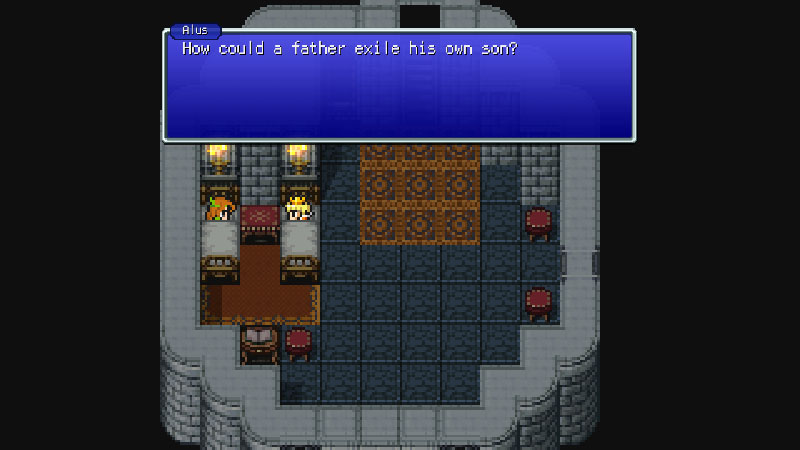
a brief tangent about scholar
This series of blog posts is about examining JRPG inspiration for use in tabletop roleplaying games, so let’s actually look at what a version of the scholar would be like.
The scholar’s unique command in the Final Fantasy III pixel remaster is called “Alchemy”. This was called “Item Lore” in the 3D remake and was not present in the Famicom, where the scholar’s only role was to use the “Scan” ability to see the current elemental weakness of bosses who could change it. Alchemy increases the potency of specific items when used by the scholar in battle based on the job level of that scholar: from 1-29, the potency is 2x, from 30-59 it’s 2.5x, and from 60-99 it’s 3x. This means that a level 99 scholar using a Hi-Potion will heal a target for 1500 HP instead of 500 HP. Likewise, this works on offensive items like Bomb Fragments, which cast the Fira spell at a potency of 55, and make the scholar an incredible DPS class…if you can obtain enough items to use. Unfortunately, these damage items are never sold in shops and most enemies in the second half of the game do not have them as a steal drop.
I like the scholar because I like logistics and resource management. Input and output are things that I can optimize and find ways to manipulate. Magic is a subjective force, and its sustainability is often limited by things like spell slots or MP. Nothing is more reliable than a grenade.
The name “Alchemy” reminded me that I’ve seen this class on the tabletop before — in Sword World 2.5. Alchemists are an Other-Type Minor Class that uses items called Material Cards to create magical effects known as Evocations. These Evocations are typically restricted to buffing the party or debuffing enemies, but nonetheless turn the tide of a battle, especially because many of them can be used as a Minor Action — allowing an Alchemist to use their Major Action on an attack or spell.
Material Cards can be purchased from the local Institute of Magitechnology, where they are priced based on their rank (from B-Rank to SS-Rank). They come in five different colors, which determine what they can be used for: Green cards are created from the essence of plants and are used for healing effects and lowering an enemy’s guard. Red cards are crafted from the essence of animals and affect a targets mobility, such as giving someone a bonus to their Initiative check or slowing an enemy . Most Alchemists manage their material card needs the same way an archer would ensure a steady supply of arrows, but in an emergency, they can perform a ritual to extract a material card from loot dropped by an enemy. Doing so is inefficient from an economic standpoint (selling the loot allows you to purchase more cards than you get from doing the ritual) but it’s exactly the sort of thing you need if you make your living dungeon-delving.
The important comparison to the scholar of Final Fantasy III is how much more agency you have as an alchemist. You aren’t reliant upon grinding an area to hopefully get a random encounter with the right enemies to potentially steal the right item from them. You are able to stock up outside of combat, and if you do need to scavenge, you are always able to obtain cards (though they may not be the specific color you want).
gulgans and bards
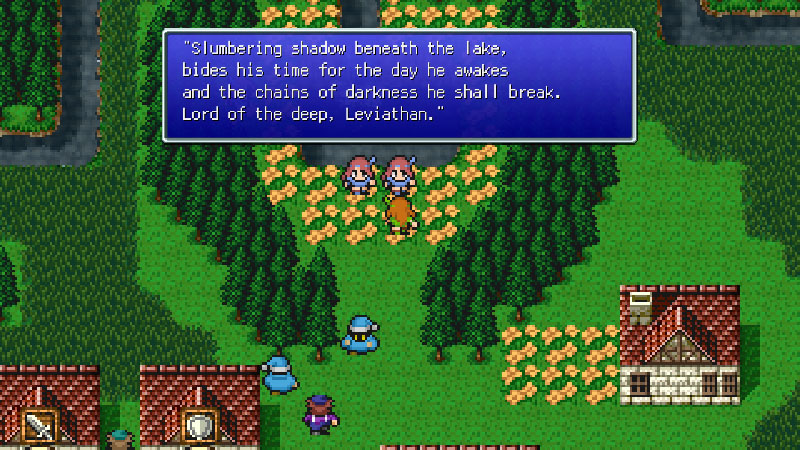
There are two factions of people in this game which interest me deeply as a GM. Gulgans are sightless sages who live in a cave. They are the ones who prophesied the coming of the warriors of light, and they foresee the great calamity that will befall the land if action is not taken. Bards are not only a player class, but also a type of NPC that appears in the latter half of the game. They recount ancient legend as recorded in song, providing key hints to the player about the world’s secrets.
Combined, the two of them represent the Future and Past, and they seem like incredibly useful tools for a campaign. In order for a game world to feel dynamic and “real”, it has to move independently of player action. The trick is that you have to communicate openly enough with players so they aren’t totally blindsided by events. It’s not a very fun game if you announce that the villain has obtained a macguffin out of nowhere without giving players a chance to stop it from happening. Gulgans, and prophets in general, are a diegetic way for you to foreshadow consequence and inform your players.
Bards likewise are another delivery mechanism for information “off the beaten path”. Most people might not know where the fairy spring is or the resting place of excalibur, but bards immortalize those details in cryptic songs. As an added benefit, they tend to move around a lot! Running into a random bard on the road is a very plausible happenstance if you need to inject a little guidance into your game without just giving players a flat answer.
I loved playing Final Fantasy III but it was a shocking departure from the unlimited freedom of Final Fantasy II. I’ve already started playing some of Final Fantasy IV, so I know that this trend of decreasing build agency only continues, but I also know that things get better in the future. The journey I am on is about learning to meet each game where it’s at and trying to find lessons I can apply to my own games. I don’t blame Final Fantasy III for its design, but I do regard it as a first draft for a system that could be great — if they stop designing puzzles for specific jobs and instead let players build their parties in whatever way they enjoy most.