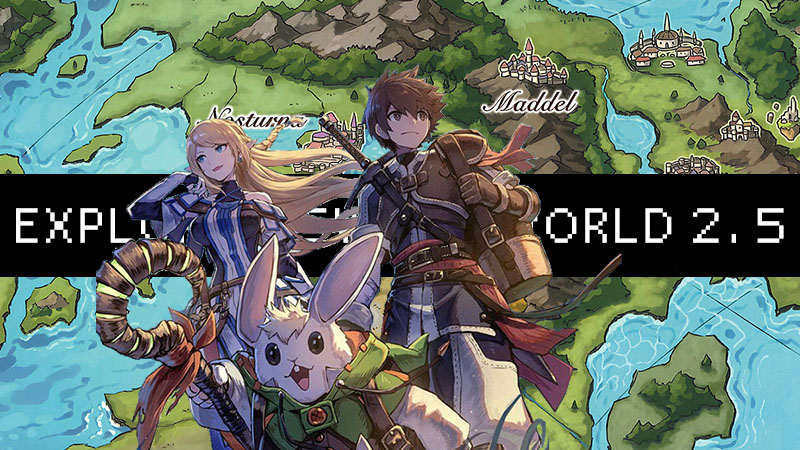
Sword World 2.5 has been on my list of games to play for several years now, ever since I saw this youtube series discussing Japanese TRPG culture. My understanding of ttrpgs was exclusively limited to the experiences I’ve had in the USA, and since then, I’ve been interested in learning how people play in other countries. Sword World remained at the top of my bucket list, but I didn’t have a chance to play it until recently. Several weeks ago, my comrades from the Paper Cult forums voted to play this game as part of our ongoing Meet the RPG collaboration.
history
In 1985, BECMI D&D was printed in Japanese. In order to demonstrate how ttrpgs work, a company named Group SNE transcribed a D&D campaign and published it in a computer magazine. These ran from 1986 to 1989, and became so popular that the DM adapted the story into a series of novels called Record of Lodoss War.
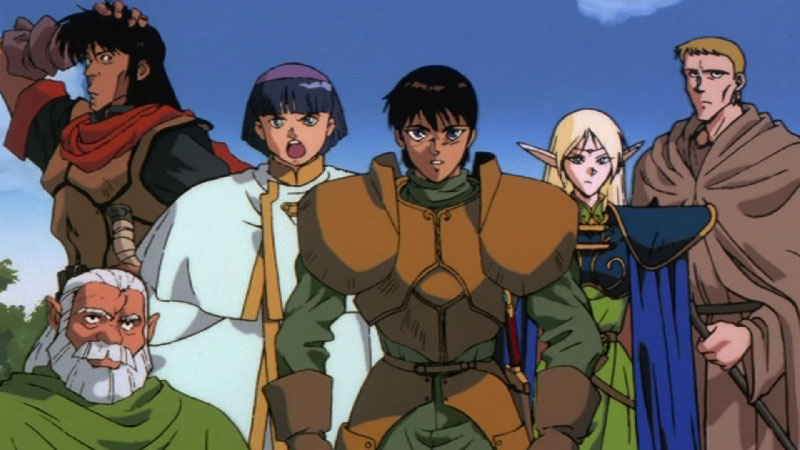
These novels became a landmark for Japanese high fantasy and spawned a whole franchise of anime, video games, and manga. Culturally, many of the tropes from modern fantasy anime take their cues from Record of Lodoss War (or subvert them). In any case, Group SNE wanted to publish an official Lodoss setting for D&D as part of this wave, but TSR denied their request. As a result, Group SNE developed a percentile-based custom system for their Record of Lodoss War Companion, published in 1989. This system was most likely influenced by RuneQuest, as it had been used some during the original Lodoss campaign.
This percentile system was quickly abandoned for a 2d6 System with the publication of Sword World RPG later in 1989. Sword World was a fresh system with a more complete setting called Forcelia, which includes Lodoss Island along with larger continents. Forcelia was also influenced by Dungeons & Dragons and RuneQuest with similar player races and magic systems.
It wasn’t until 2008 that Group SNE published Sword World 2.0 which had a completely original setting with no ties to Lodoss or D&D. Sword World 2.5 was published in 2018 with the same setting and more streamlined rules.
The way I’ve been thinking about this is that it’s like if Pathfinder released in 1989 instead of 2009, or if Daggerheart was published in 2008 instead of 2025. Sword World had its schism from Dungeons & Dragons decades ago and has been developing as a divergent evolution for a much longer time than those more recent games. When you read Sword World, you can clearly see that it was written to afford D&D-style games, but mechanically and culturally, it’s operating on a completely different paradigm.
setting
In order to understand Sword World, you need to understand the setting of Sword World. First: the name is literal. The world of Raxia was created by three sentient swords of unimaginable power. These swords of genesis longed for people to wield them, so they attempted to create creatures capable of doing that. After several failed attempts, they eventually created humans. One such human named Lyphos discovered the First Sword of Genesis, Lumiere, and gained previously mentioned unimaginable power.
As it so happens, Lyphos and Lumiere are both really into harmony and they use their god powers to make the world a better place for humanity. They also start making copies of the First Sword and giving them to other humans which turns them into slightly-less-powerful gods, and those gods would go on to make other species like elves and dwarves.
Meanwhile, the Second Sword of Genesis, Ignis, is found by a guy named Dalkhrem. Dalkhrem is jealous of Lyphos and wants to conquer the world about it. Ignis is associated with the ideal of freedom, and empowers Dalkhrem to pursue his goals regardless of the consequences. In order to wage war against Lyphos and the other gods, Dalkhrem gathered creatures and scarred their souls to empower them and make soldiers that would not restrain themselves in battle. These creatures would become known as the Barbarous.
The War of the Gods raged for thousands of years. During that time, the Third Sword of Genesis, Cardia, was found briefly by a wielder named Kilhia, who would become the god of wisdom. Cardia similarly is associated with knowledge and magic, and it decided that it didn’t want to get drawn into the war between its siblings. It shattered itself, scattering shards of itself across Raxia, which would allow mortals to use magic. After the warring gods tired themselves out and went to sleep, mortals were left to fight against the remaining Barbarous forces in a dark age. It was the magic of Cardia that allowed them to drive the Barbarous off and establish empires as sorcerer-kings.
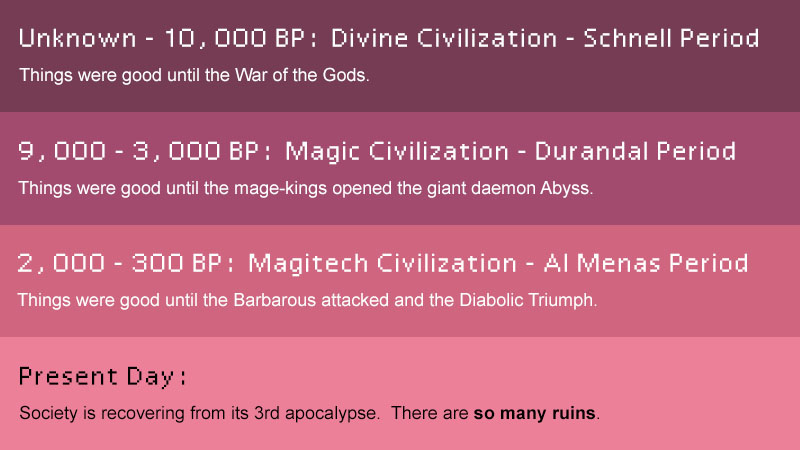
To cut a long story short, life in Raxia has gone through three major ages of prosperity that were abruptly ended due to calamity. This has created a world filled with ruins where most of the technology and magic lies buried. After the mage-kings unleashed daemons into the world, society established a network of guardians who worked as first responders to daemon incursions via abyssal tears. This network would become the precursor to the modern adventurer profession as society relied more and more upon the guardians.
Adventurers are brave individuals who explore dangerous ruins and ancient sites, exterminate monsters and act as guards or escorts on long journeys on behalf of the powerless.
…
On the Alframe continent, adventurers are dependable, respected, sometimes feared, and occasionally revered. Above all, they are considered symbols of freedom.
– Core Rulebook 1, Page 330
expectations of play
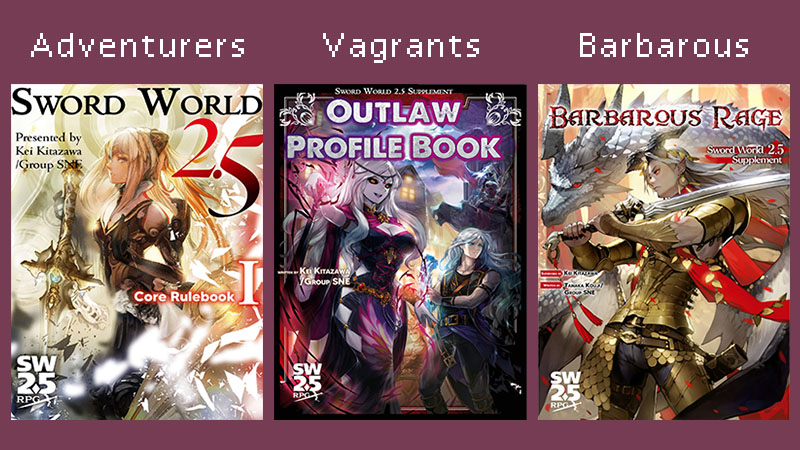
The default mode of play in Sword World 2.5 is that of an adventurer. The book expects you to be an individual who works for the greater good of society by risking your life. Unlike D&D, there isn’t even a suggestion of an alignment grid. In fact, if you want to play someone with selfish or mercenary motivation, like an anti-hero, the game provides a supplement with separate rules allowing you to play as a vagrant. While vagrants can use many of the same classes as adventurers, they get different feats and are deprived of the mechanical benefits of adventurer guilds. If you want to go even further and play as an evil character, the game has several barbarous supplements designed around villainous campaigns. All of this emphasizes that these are exceptions to the norm and considered an alternative ruleset.
we need to talk about the barbarous
Sword World has a variety of killable peoples, but the Barbarous are the biggest red flag in this game for me. As Dwiz explains, when your enemies have intelligence, culture, and society, it becomes ethically uncomfortable to treat them as sword-fodder. The Barbarous are not inherently evil. They were created when Dalkhrem scarred the souls of creatures to make an army. That’s not a metaphor; souls are tangible objects that can be scarred by magic, and the number of soul scars a creature has affects their outward appearance and desires. It is a scientific, measurable process, and it happens to everyone.
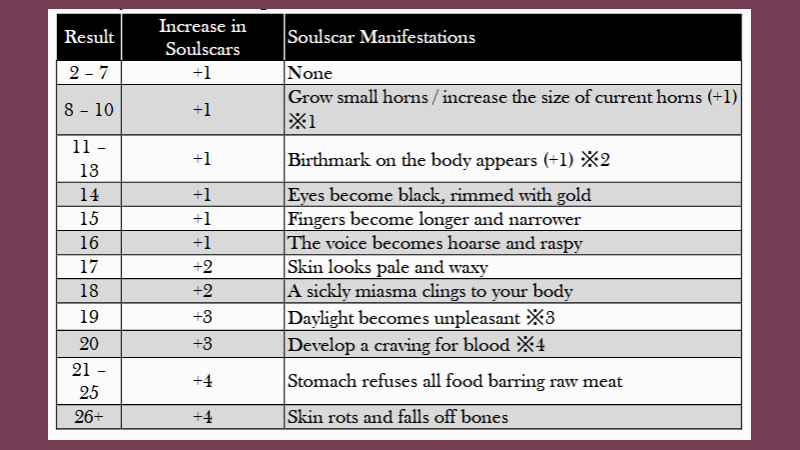
Each time a character is revived by magic, they gain a soulscar. Depending on the circumstances of the resurrection, the manifestations of the scarring might be more or less pronounced, but they are effectively identical to common traits among the Barbarous.
With this in mind, there is a very generous reading of the game that treats the Barbarous as the tragic victims of a would-be conqueror and a society that has perpetuated those ideals for thousands of years. The story of Raxia is that of a cycle of violence between the children of Lyphos and the children of Dalkhrem where both sides have been killing each other since time began. Challenging that cycle and the societal prejudices of humanity is very interesting to me from a narrative perspective. The most recent apocalypse was a mass invasion from the Barbarous called the Diabolic Triumph, and the majority of Barbarous on the surface of Raxia are remnants from a militant invasion force. This invasion happened because the Barbarous had been forced underground by the Humanoids using magical swords that project an aura of harm to anyone with soulscars (including resurrected adventurers). It’s extremely messy, and a careful reading of the lore should make you realize that there are reasons for fighting the Barbarous, but humanity is certainly not blameless. It should make you uncomfortable, but the setting is not bioessentialist, and resolving those issues makes for compelling worldbuilding.
On the other hand.
The game is rarely so generous with its self-perception. Many of the example scenarios and unspoken expectations are that you will fight the Barbarous as an existential evil. I think this is equally because adventurers work at the behest of human society, but also because the game rarely takes such a critical look at itself.
Understanding the nuances of the Barbarous situation is one of the main things that will make or break this game at your table. It should be a discussion during your safety procedures to make sure everyone is on board with these topics.
playing the game
Before I get too deep into the weeds here, let me give you some basic context. Playing Sword World works much the same as traditional-style ttrpgs like Dungeons & Dragons. There is one GM and several players, each of whom roleplays as a single character. When a player wants to do something risky, they roll the dice to determine whether they succeed or fail. Sword World uses a 2d6 resolution system: in fact, the entire game only uses 2d6 for all rolls. This was a deliberate design choice, as polyhedral dice were difficult to find in Japan when the system was being designed.
Our table played a total of four sessions. Session 0 was equal parts presentation & safety briefing as well as a couple hours of character creation. This is not a system you can roll up a character in a few minutes the first time you play it. I do think it would be fairly easy to make characters after experiencing the game, but there are simply too many options to read and evaluate as a newcomer to do it quickly.
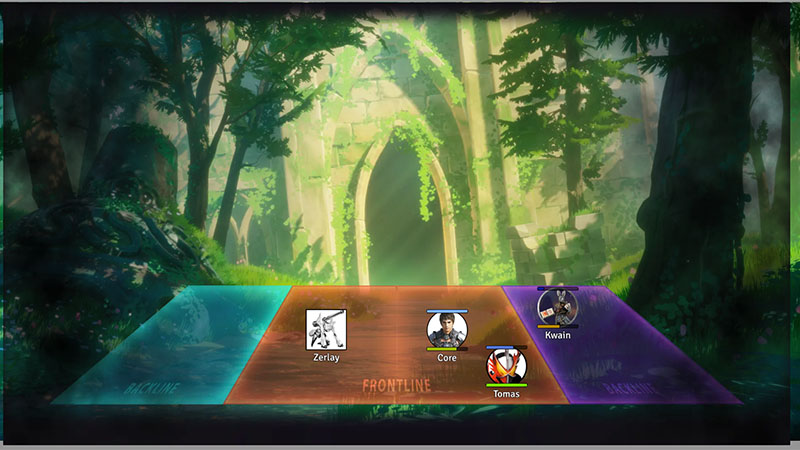
Session 1 was a straightforward on-rails adventure directly modeled after the sample scenario provided in the first core rulebook. Scenario design is its own topic and could be the subject of an entire series of blog posts, but I’ll touch upon Sword World’s unique expectations in a moment. The players accepted a quest from the Adventurer’s Guild to go find some lost ruins and set out to explore the forest. They ran into some Hoodlings (small goblin-like creatures) and engaged in some basic combat. Afterwards, they followed the trail left by the Hoodlings back to an ancient battlefield and then on to the ruins they were looking for. The climax of the adventure was a battle with a construct called a Zerley.
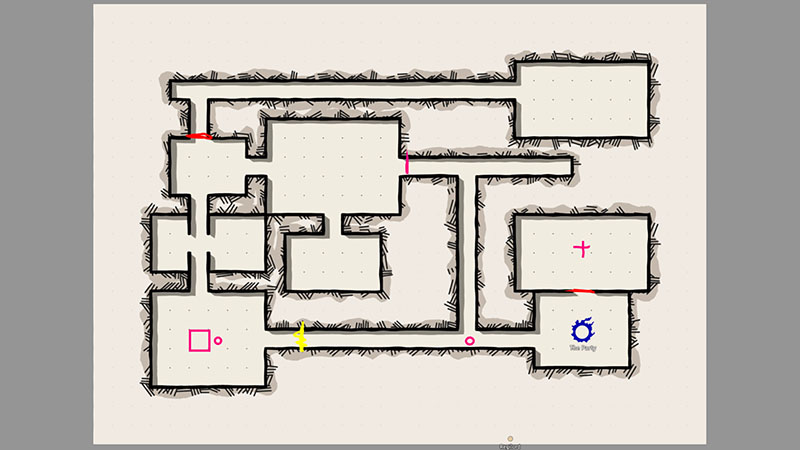
Sessions 2 & 3 were a dungeon crawl through a Sword Labyrinth (more on this soon). Unlike the first session, this exploration was much more self guided, and similar to adventure site design. I employed the first level of the Shard Eater Labyrinth provided in the Granzale setting guide with some modifications to scale it up to adventurer level 6.
scenario-based design
This is how Sword World describes the process of running a session of the game.
First, the players introduce their characters to each other, and the GM will describe the current situation the PCs are in. The purpose of this step is to provide the general context of the session as well as the general objective. For example, “A group of Barbarous have been raiding a farming village. An official request has been made to the Adventurer’s Guild to stop them, and the guild believes this quest is ideal for new recruits.”
The GM should describe the scenario briefly, as it is merely a taste of things to come. You should clearly communicate the purpose of the scenario to avoid problems with meandering and dilly-dallying.
Second, the GM will introduce the “starting plot” or first scene. In this example scenario, this is a brief opportunity for the players to ask the guild about the details of the request and the attackers before the GM moves to the next scene, which is on the way to the farming village. While the players are free to act in these scenes and choose how to proceed, the GM is expected to keep things moving and cut to the interesting parts.
However, if a player blatantly goes against the spirit of the scenario, the GM should politely but firmly guide and advise the player to follow the scene. Even though each player has some independence as to how their character acts, they shouldn’t actively bring the level of excitement down for everyone else.
The session continues with players advancing the story by moving from scene to scene until the climax, which should be a “thrilling scene”. Battles seem to be the most common type of climax, but I can imagine any type of tense situation works just as well. Finally, everything ends based on the scenario’s objective. Once again, this objective should have been clearly stated from the beginning, and the rewards are based on whether or not that objective was successfully completed.
What I found particularly interesting was how this design philosophy worked on strict railroad-type adventures as well as our freeform dungeon crawl. Both of these had objectives — the first was to find the ruins, while the second was to fulfill five Labyrinth Requests. In the latter case, these were sub-objectives achievable by exploring the dungeon, ranging from collecting ingredients to defeating specific bosses. I enjoy the clear, direct communication that an objective statement provides. I think it eliminates beating around the bush when players have a limited amount of time to play, and it’s freeing as a GM to be able to explain the broad strokes of your design rather than limit yourself to painting a diegetic picture and hoping everyone at the table picks up on it. It’s an approach that I would take in any game that isn’t trying to be a perpetual sandbox, and even then, I like when the players have concrete short-term goals to build around.
ruins, labyrinths, and shallow abysses
There are three types of dungeons in Sword World. The first is the humble ruin, which can be found all over the continent due to the fact that three major civilizations have risen and fallen to calamity. The most recent of these was only 300 years ago, and Magitech ruins are the most common accordingly. Adventurers explore these to find lost technology, and they are equally endangered by ancient security measures such as robotic constructs.
The second type of dungeon is the Sword Labyrinth. As you might expect, Sword World is chock full of swords, created as replicas and copies of the Swords of Genesis. These replicas are sentient and hold powerful magic, and are incredibly picky about who can wield them. In order to keep themselves from falling into the wrong hands, they conjure labyrinths around themselves filled with traps and monsters as deadly guardians. More powerful swords are capable of creating more dangerous labyrinths; whoever reaches the deepest part of a Sword Labyrinth becomes the master of that sword.
The third type of dungeon is the Shallow Abyss, which is a tear in reality that sometimes forms like a natural disaster. The mage kings of the ancient magic civilization created The Abyss through a failed large-scale daemon summoning ritual, which ripped a chunk out of the northern part of the continent and left it exposed to the daemon realm. While they were able to build a giant wall to mostly keep the daemons at bay, Shallow Abysses occasionally form across the continent as smaller, temporary tears. In practice, these are “wilderness dungeons” that operate on dream logic. Each one has an Abyss Core that must be destroyed to prevent the Shallow Abyss from growing larger (you must also destroy it to escape).
What I really like about the dungeons of Sword World is that none of these three are colonialist, nor are they involved with the Barbarous as enemies. In particular, I love the idea of Sword Labyrinths as artificial dungeons created to test adventurers. This justification allows you to play into classic dungeon tropes without having to suspend disbelief wondering why someone would build a structure that’s so inconvenient to move around in. Shallow Abysses and ruin exploration also feel good as a player, because they don’t have the expectation of personal gain. The former is disaster relief, plain and simple. Ruin exploration is almost always done to recover lost knowledge for the good of society as a whole — a rebuilding effort. From what I can tell, adventurers make the lion’s share of their income being paid by the adventurer’s guild (which is commissioned in turn by scholars) rather than from treasure they find.
adventurer guilds
I have blogged before about adventurer’s guilds from the perspective of fantasy anime. It is my belief that one of the common ancestors of modern fantasy anime adventurer’s guilds is the setting of Sword World, though admittedly I haven’t read earlier editions of the game to verify. Regardless, Sword World 2.5 is all in on adventurer’s guilds as the ultimate support network.
The headquarters of the Adventurers’ Guild is located on that giant wall protecting humanity from the daemon Abyss. That Guild has branch offices across the continent operating as franchises. Each individual guild branch has its own name, such as “the Dragonfire Branch” or “the Smiling Goddess Pavilion”. These businesses receive commissions from clients, which it uses to pay adventurers to go on quests. It then makes a profit by bulk purchasing loot brought back by adventurers (such as artifacts, books, special materials, or forgotten knowledge), which it then sells to interested parties. This style of business has been compared to selling pickaxes during a gold rush, and I think the metaphor is pretty apt: the Adventurers’ Guild is not an organization of adventurers, but rather an organization which supports and profits off of them.
Guild branches offer a variety of services; the most basic of these is room and board. Most offices either operate as an inn and tavern or partner with one in close proximity. In addition to food and lodging, these locations post requests from clients and handle the paperwork associated with accepting a job. Some branches also offer adventurer training and will sell basic equipment to those getting started. Once you have registered with the guild and completed at least one request, further services are available, such as:
- Payment in advance without interest or collateral
- Resurrection loans without interest or collateral
- Rescue and body recovery services
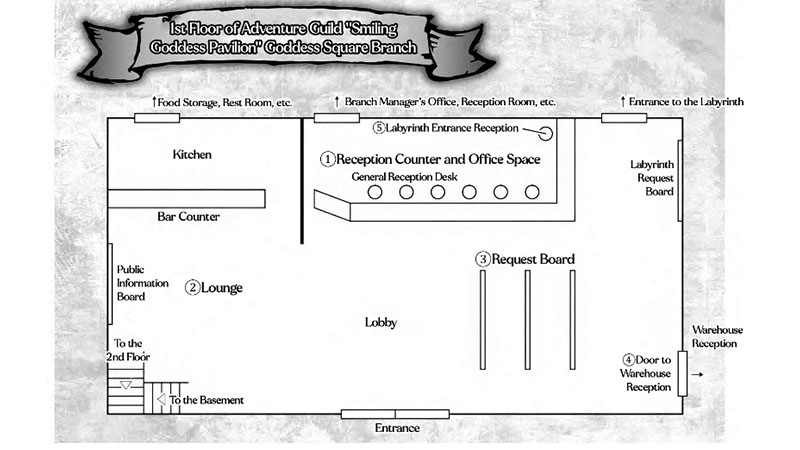
Guilds may also offer services specific to their location. The Smiling Goddess Pavilion guild is directly on top of a sword labyrinth, so it has a separate request board specific to labyrinth requests. The guild also sells partial maps of the labyrinth (the room interiors change frequently), and adventurers must purchase a ticket from the guild in order to enter. In addition to Adventurers’ Guild membership, all guilds in the city of Granzale require you to have a “Granzale Adventurer’s Registration Card” to use Granzale guild services. I hope you’re beginning to understand the levels of bureaucracy at play here.
The final thing I want to mention about guilds is the Adventurer’s Insurance, which can be purchased at certain Adventurers’ Guilds. This is a formalized process by which, if an adventurer goes missing for a certain time after taking a request, the Guild will conduct a search. If that adventurer is dead, Resurrection will be cast on them — completely paid for by the policy. If the subscriber does not wish to be resurrected, a designated beneficiary will receive a death benefit for the duration of the policy period. Subscribers pay a monthly fee for this service, and receive a separate “Adventurer’s Insurance Card”, which is recommended to be kept on a different part of the body than the Adventurer’s Certificate (Granzale Adventurer’s Registration Card) or the Venture Crest (Adventurers’ Guild membership).
In principle, the insurance will pay the cost of [Resurrection], but if the subscriber’s negligence is judged to be significant, such as if they challenged a monster that clearly exceeded their ability without good cause, the insurance payout will only be loaned to the subscriber.
This is what it means to be an adventurer in Sword World.
classes and adventurer levels
Each player character in Sword World 2.5 is made up of a collection of classes. While multiclassing is not strictly enforced like in Fabula Ultima, making a character with one class would be like making a character with a single stat in D&D. This is because each class is treated as a package of skills that is added to your 2d6 and stat modifier:
If you want to attack with a melee weapon, you roll 2d6 and add your dexterity modifier and your Fighter, Grappler, or Fencer level. If you want to attack with a ranged weapon, you add your Marksman class level. If you want to avoid getting hit, you add your agility modifier and your Fighter, Grappler, or Fencer level.
If you do not have a relevant class, you cannot add your stat modifier to rolls and must roll “flat”.
This means, for example, that someone without a martial class will never be able to hit a monster with an Evasion score of 12 or higher (the passive side wins ties). This skill system applies to more things besides combat:
- Scouts and Tacticians are the only classes that can roll initiative
- Sages are the only classes that can roll monster knowledge
- Rangers are the only ones who can roll first aid.
- Characters without Scout or Ranger are unable to roll Danger Sense or Spot Trap which act as saving throws for ambushes and traps respectively.
Classes are split into Major and Minor classes. Major classes require more experience to level and are typically useful in combat situations. Minor classes grow faster but have narrower applications and are more utility-focused. A well-balanced adventurer uses a mix of both to ensure they are combat capable and also useful outside of a fight.
Adventurer Level is the highest class level that a character possesses. This is important because the game’s balance is based on the average adventurer level in the party. If one person decides to dump all of their experience into their major class without rounding themselves out, it can endanger the rest of the party. On a similar note, the game offers no safety rails for unbalanced party composition. If nobody decides to take some levels in Scout or Tactician, then the party can only roll a flat 2d6 for initiative, and many enemies have initiative higher than 12.
minor notes of appreciation
Honestly, I could probably talk about Sword World for another thousand words, but in the sake of brevity, I’ll limit myself to a few more points that I really liked about the system.
First: it’s so nice that there is no vancian magic rules. There are no spell slots; there is no limited amount of spells you can learn per level. When you are level one in a magic class, you learn all the level one spells. When you are level two, you learn all the level two spells. Simple as. Furthermore, these spells cost MP to cast, and MP can be recovered fairly easily through Mako Stones (shards of Cardia) or Magic Herbs (applied by a Ranger). Wizards feel like wizards. No fucking around with “I can only cast Fireball once a day”.
Second: enemies have no derived stats. While this made encounter balancing difficult in some ways, it was also refreshing in other ways. I didn’t have to worry about giving a monster a huge accuracy bonus just because I wanted to raise its evasion score. Enemies don’t have strength or dexterity, they just have specific attacks, skills, and spells, which have bonuses completely independent of one another. It’s easy to have a strong and weak attacks on the same monster.
Third: the gridless nature of Simplified Combat was quick and enjoyable. Sword World technically has three combat procedures, though we only used the Simplified Combat, which reduces the battlefield to a skirmish area and two backlines. This combat was the inspiration for Ryuutama (which has inspired my own game design) and Ryuutama also inspired Fabula Ultima, so this design was very familiar to all of us. The major twist is the fact that initiative is side-based. Whoever wins the initiative has all of their members go, and then the other side goes. This is why it’s particularly difficult if a party doesn’t have a reliable Scout or Tactician — letting all of the enemies go first can sometimes be lethal.
Fourth: the Sword Labyrinth we played had a really unique safety net. The magic sword at the center of the labyrinth conjures a Guide on each floor. Once adventurers find the room with the Guide, they can summon her and exchange limited currency (sword shards) for services like health restoration, weapon enchantment, or unlocking doors. While not endless, this was a really cool way of offering some grace to starter adventurers who might not have all the party roles covered.
Sword World 2.5 is an enormous game with a world I fell in love with. While I would make some personal tweaks if I ever played it again, I would be happy to get the chance. I highly encourage anyone interested to check out the kickstarter for the English translation when it launches.
Additional Reading:
- Chris Casey’s Sword World Overview blog series
- Mugen Gaming’s website for the official English translation of Sword World 2.5
- /r/SwordWorld and their helpful discord and fan translations