
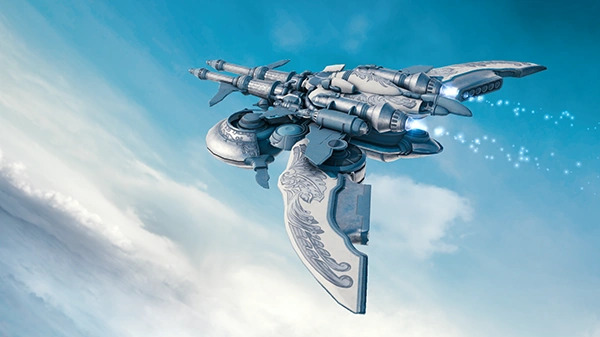
We started preparing for our GURPS mini campaign about two months ago. Myself and several other intrepid explorers from the Paper Cult forums have been running a variety of our unplayed games in an effort to “Meet The RPG”. GURPS was chosen to be the latest subject of our ttrpg book club.
I had played GURPS briefly in a handful of pick-up games during one of my summers in college, but it was an informal setting and most of the character creation was pre-made. Our GM, AstralFrontier, was much more experienced and offered to run the game for us. I was joined by four other players for a larger-than-average party. The size of our group made it a little difficult to reach consensus on the type of game we wanted to play, but ultimately everyone latched on to the idea of playing as sky pirates inside of a dyson sphere. GURPS excels at unifying a wide variety of character concepts and the initial idea was to have a bunch of weirdos on an airship.
starting with the ship
We didn’t need to make a ship.
I wanted to make a ship because I was attached to the idea of having a really cool ship, like the Millennium Falcon — a ship that is as much a character as it is a prop. The first obstacle I ran into is the fact that GURPS doesn’t really support the idea of objects having narrative weight. By default, there are no mechanics for establishing that this ship is important. I wanted to spend my character points on establishing that I was the ship character, but GURPS doesn’t provide mechanics to do that directly. This is why I decided to start with the ship itself, and then build the character perfectly suited to pilot it.
Astral gave us carte blanche to get whatever we needed in terms of equipment and ship stuff, and I ran with it. I started by looking in GURPS Campaigns — the equivalent of the DM Guide — for vehicle rules and found only basic examples of mundane vehicles. After consulting with Astral about the issue, we added GURPS Spaceships and GURPS Spaceships 7 to our library.
At this point, you might be asking, “Serket, why do you need spaceship mechanics for your sky pirate game?”. When I pitched sky pirates to the group, I was thinking about Final Fantasy 12 and said as much, knowing that Astral was familiar with the series:
I haven’t been making Millennium Falcon references for nothing. Those are TIE fighters. That’s a fucking Star Destroyer. This is just fantasy Star Wars (which is already fantasy but I digress).
The airship I want to make is a high-performance speed demon with aftermarket guns and a smuggling compartment. What I would not discover until the first session is that many other members of the party were picturing the slow-moving sailing ships of Treasure Planet with rigging and deck combat boarding actions. Despite thinking that everyone else understood my vision given the lack of questions, we had different ideas about the type of airship we’d be flying. This is your friendly reminder to always double-check, even if you think you’re on the same page.
In any case, this is why I felt the need to reach for mechanics designed around high-speed maneuvers with auto turrets and afterburners. GURPS Spaceships provides a framework for building your ship as a series of three hulls with six systems each. Each system is a component like a cargo hold or an engine room and is vulnerable to damage if attacked. Incoming attacks normally target a particular hull section and randomly determine the system hit, while precision attacks may specify a system. Accordingly, ships are outfitted with defensive armor or force screens (energy shields) to defend against attacks.
All of this is a giant balancing act that took me several days to figure out. Guns and engines required energy which meant having enough reactors on board and force screens to protect them. I wanted the ship to be small but bigger than a fighter, and the size category limits how much armor can be added. On top of that, we were also using GURPS Spaceships 7, which provides statistics for magical and fantasy materials. These systems were often much less effective than the high-tech components of default Spaceships, which served as an extra wrench in my calculations.
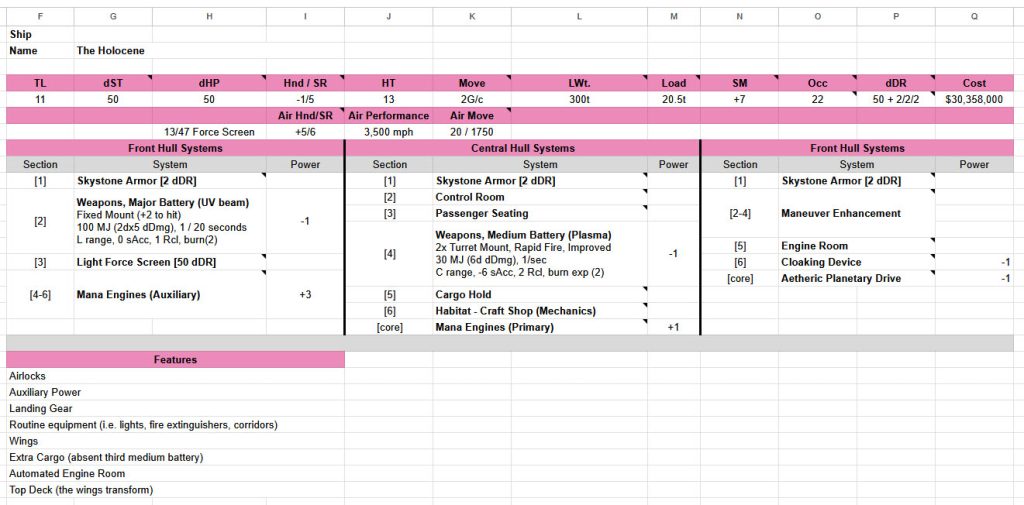
Yes, she’s overkill. She’s also beautiful.
a pilot and a friend
After several days of losing myself in ship mechanics, I was finally ready to make my character. My experience with the ship meant I knew that I wanted someone with good Piloting and the ability to fire energy weapon batteries. Ideally, they would also be able to fix the important parts of the ship, such as the hull and engines. I planned on establishing the narrative importance of the ship by creating a character defined by the focus of her skills as a pilot. However, I felt a little guilty about bringing such a “selfish” character to the table — she would necessarily be less effective in combat due to that focus. To that end, I relied upon Han Solo’s other defining trait: his reliable best friend Chewbacca.
Before I get into that, let’s talk about the anatomy of a character in GURPS.
While the ship was a series of components (normally purchased with money), a character is a collection of features purchased with character points. Everything from basic attributes to superpowers has a pre-defined point cost, and players are able to spend their budget however they please. For our campaign, Astral gave us 125 points as starting adventurers. From there, it became an optimization problem.
My character needed a few specific skills, which each had point costs assigned based on the learning difficulty. If I needed enough skills that used a certain basic attribute (strength, dexterity, intelligence, health), it became more economic to spend points raising that attribute than each skill. Given that raising attributes is incredibly expensive, I chose to limit my skill selection to a limited handful.
In addition to skills and attributes, GURPS also presents advantages and disadvantages, which are powerful traits that define a character — things like the ability to fly or common sense. Disadvantages give your character additional points to spend but present problems and challenges in play, like a vulnerability to holy water or impulsiveness. Finding the balance between the two further complicates our optimization puzzle. Ultimately, I found a mix that I was happy with, and allocated 20 points for an ever-present NPC ally built using the same character point budget as my main character. This allowed me to create someone who would be useful to the party in a fight.
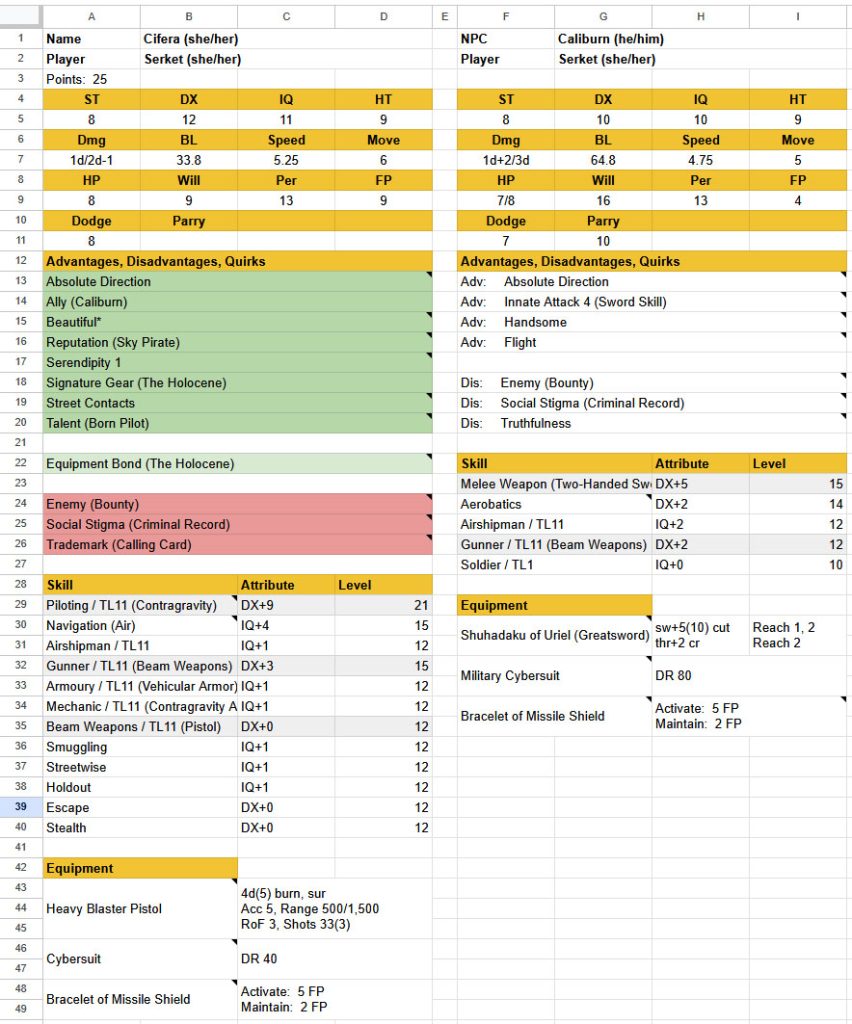
Caliburn, my NPC ally, was an experiment to see if I could recreate Agrias from Final Fantasy Tactics in GURPS. Ultimately, I did not pursue it as far as I could have, because it would have overcomplicated the game and made Caliburn more of a detriment, since I would have had to take on more disadvantages to get the points I needed. Even without all of the unique special effects, I was very pleased with how everything turned out with his sword skills.
the game in practice
All of this character building took me roughly a week — several nights of pouring through the various GURPS tomes trying to find the most efficient way to execute the visions in my head. It was exhausting but I loved it. Cracking this sort of optimization challenge is my bread and butter. Despite all of that work, or perhaps because of it, GURPS is really simple in practice.
On a fundamental level, it’s just 3d6 roll under.
Compounding this simplicity is the fact that every DC is already listed on your character sheet. If I need Cifera to roll a stealth check, I just need to roll a 12 or less on the dice. The only thing that the GM needs to worry about are situational modifiers that make the roll easier or harder. If Cifera is trying to sneak through an open field, that could be a -4 modifier, applied to the DC. In that case, I’d need to roll a 12-4=8 or less on 3d6. This is why Cifera’s piloting skill is 21: that’s about 5 extra steps of difficulty “padding” before I have a chance at failing a roll (rolling 17+ is always a failure).
The campaign itself was enlightening, as I got to see the result of everyone’s character-building approaches under the same circumstances. Out of everyone at the table, I spent the most time on my characters and specialized to an extreme. In comparison, another player took almost twice as many skills and was able to contribute in a wider variety of situations. Neither approach struck me as incorrect, and many players were somewhere in the middle.
The ship outperformed every challenge Astral threw at it. This was what I wanted and my work paid off. Likewise, Cifera outpiloted every situation Astral could muster while still keeping things fair. She was built to do one thing and she performed as intended.
Caliburn’s performance surprised me. I should start by saying that the intent of GURPS is that ally NPC’s are played by the GM, but due to the scenario I was allowed to play as Caliburn since Cifera was solo piloting the Holocene away from the rest of the group. In any case, I was extremely pleased that he was able to deal devastating near-unstoppable magic damage with his sword skills…right up until another party member used a rapidfire gun to mow down more enemies with significantly less point investment. There’s certainly something to be said for the fact that Caliburn will never run out of magic sword skill, and it does bypass armor completely, but the attack I developed wasn’t economically efficient with the setting’s tech level.
Setting my characters aside for the moment, one thing that struck me about the feel of the game was how similar in structure it is to the principles of the OSR. Once you leave the realm of character creation, you exist in a state of tactical infinity. Our party was trying to barricade a room, and a different game might abstract that with clocks or skill challenges. In GURPS there is only the HP and defenses of the door and anything you shove in front of it versus the damage output of the people breaking in. While you can argue that HP is both a clock and an abstraction, GURPS treats it as a fundamental measurement — a common denominator that all objects can be reduced to. The game is simulationism taken to an extreme, and without the fingerprints of design, I feel no passion for it.
fingerprints of design
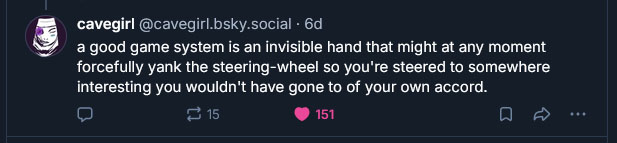
This bluesky post by Emily Allen (of Cavegirl’s Game Stuff) has been buzzing around in the back of my head for a few days:
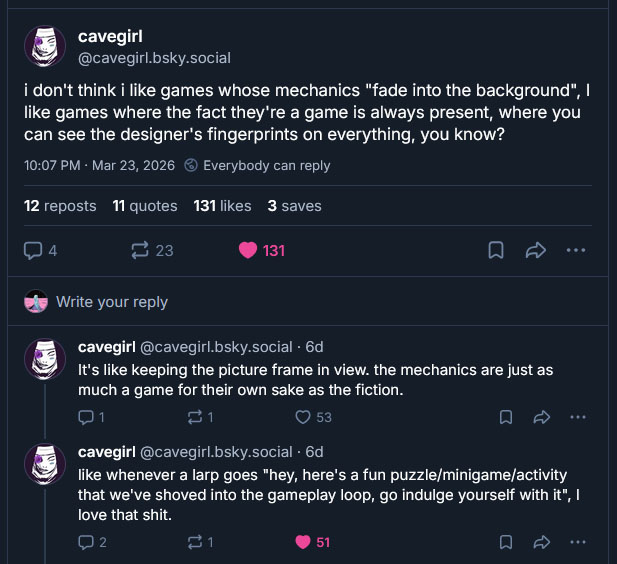
GURPS is meant to be the Generic Universal RolePlaying System, which means it cannot show favoritism to any system or mechanic. For example, there are no rules for making travel rolls or downtime activities or crafting: these are examples of things another game might care about, but GURPS only cares about the measured representation of the game world. There are optional rules, but they only seem to simplify or add complexity to base mechanics while maintaining the same goal of simulation. A game might use Wildcard Skills to decrease the granularity of large skill lists, but they do not effectively change the input or output of the skill system. GURPS Spaceships includes a much more detailed space combat procedure to simulate zero-g maneuvers at high speeds, but this too is simply an optional replacement for the basic vehicle combat in GURPS Campaigns.
I had fun playing GURPS. I believe in the idea of GURPS as it existed in the past. I’m just not sure whether there is a point to GURPS in 2026 with the amount of games that exist. This is the ultimate conclusion of system matters: why would I play a universal system when there is probably a game that actually cares about the thing that I’m trying to do. I want my game to be opinionated rather than indifferent.
2 Comments
Good article. Just a counterpoint to your conclusion “I’m just not sure whether there is a point to GURPS in 2026 with the amount of games that exist”. As a GURPS lover I would way say instead that GURPS does it so well for me that I don’t need other systems. I seems to be that lately every time someone comes up with a great new milieu or storyline they feel the need to make a new game to play it. For me & my group I would much rather use GURPS so that we don’t have to learn yet another set of rules. IMHO YMMV. Game on!
The whole thing about GURPS not having mechanics for making a ship feel like a character is such a classic system design problem—glad you found a workaround by basically building backwards from the ship itself.