Have you ever thought to yourself: “I wish my fantasy campaign had a deckbuilding minigame like Triple Triad, Gwent, or Pazaak“? Would you like something more mechanically involved than doing an opposed luck check but not something that would completely derail the session?
I have these thoughts. I have these demons — the minigame demons — and they haunt me.
Establishing an in-universe deckbuilding game is great! It gives you a diegetic reason to have collectables as a type of loot completely unrelated to combat design or even the economy at large. A rare trading card is something special, yet it also won’t disrupt any of your careful game balance. I knew that I wanted to build something for my Fabula Ultima campaign, but I wasn’t sure what it would look like or even when it would happen. Well, inspiration struck me on Monday and I had a prototype ready by the session on Thursday.
how to play
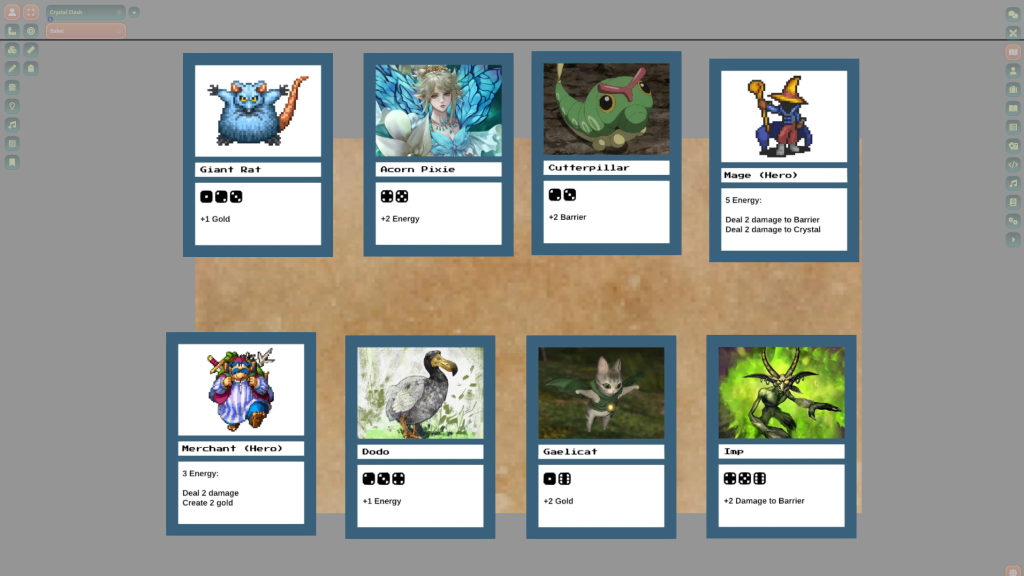
Each player has a deck consisting of 1 Hero and 3-5 Party Members. Additionally, each player has a Crystal: the goal of the game is to break your opponent’s crystal while defending your own. Only the Hero is capable of dealing damage to a crystal; your Party Members support the Hero and remove obstacles.
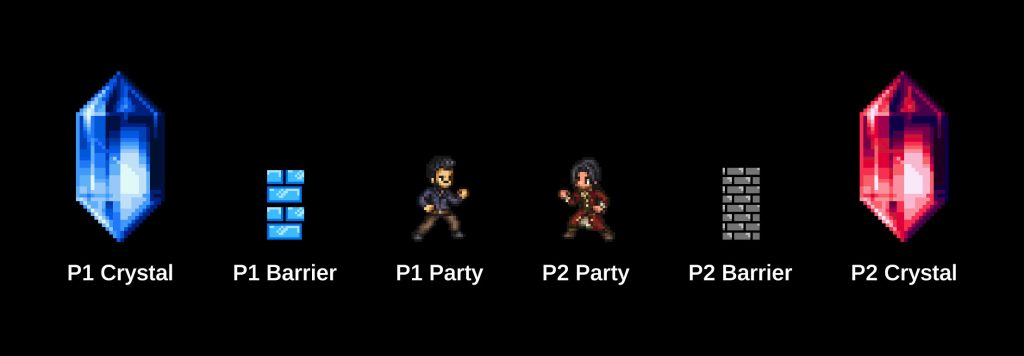
At the beginning of the game, each Crystal has 5 Health and 2 Barrier. The barrier’s appearance is unique to your deck’s hero: for a mage, it might be a magical forcefield, while a demon’s barrier might be a horde of minions. It exists to be a layer of protection for your crystal, but it can be damaged by enemy Party Members. Unless stated otherwise, your Hero will deal damage to any Barrier present instead of the Crystal.
The game takes place over a series of rounds where each player rolls some dice and resolves their effects simultaneously. At the beginning of the game, players roll 2d6. Each Party Member has one or more numbers which must be rolled to activate their ability. For example, a card might have “[4, 5]: +2 Barrier”. If you rolled a 4 on a die, you may assign that die to activate the card and gain 2 Barrier during the resolution phase. You may add dice together to activate a Party Member, but the number must be an exact match: adding 2+2=4 would work, but adding 3+3=6 would not. Barrier can never be greater than your Crystal‘s starting health.
Players may gain more dice by leveling up their party. They do this by spending an amount of Gold equal to the number of dice they currently roll. For example, at the start of the game, players can spend 2 Gold to level up. On the next round, they will then roll 3d6. Any leftover Gold “rolls over” so if the player needs 3 Gold to level and they gain 4, they will level up once and have 1 Gold left over. Players may level up more than once per turn if they have the necessary Gold.
Finally, Heroes require Energy to activate their ability. This is how players attack their opponent’s crystal and win the game. Each Hero is unique and will deal damage differently. For example, the Thief hero requires 3 Energy to activate and will deal 1 damage directly to the enemy crystal. To contrast, the Fighter hero also requires 3 Energy but deals 3 damage. This deals much more damage than the Thief, but does not ignore the barrier. Like Gold, Energy “rolls over” so any excess remains after the Hero‘s activation. Players may have multiple Hero activations if they have the necessary Energy.
Resolution happens simultaneously in a series of phases. If the players are going against an NPC, their actions happen “first” during a phase to prevent draws. If players are dueling amongst themselves, everything is simultaneous, so draws are possible if they destroy one another’s crystal at the same time.
- Gold
- Any gold generated by party members is tallied. Level up as appropriate and note the remaining gold.
- Barriers
- Any barrier generated by party members is tallied.
- Party Attacks
- Any party attacks happen, dealing damage to opposing barrier as appropriate.
- Energy
- Any energy generated by party members is tallied. If there is enough energy for a hero activation, it happens next and the remaining energy is noted.
- Hero Activation
- If a hero is activated, perform its effect and deal damage as instructed.
After the resolution phase, if both crystals are intact, a new round begins. This cycle repeats until one crystal is destroyed.
To recap: players roll dice and assign them to matching Party Member cards. Once each player has finished assigning dice, resolve the effects simultaneously. By spending Energy, the Hero will attack the enemy crystal and claim victory. Gold increases the amount of dice you roll, while Barriers provide additional protection.
designing the cards
Each card should have a rarity which broadly indicates its effectiveness. The Fighter, Mage, and Thief heroes are “common” and correspondingly have very basic abilities with inefficient costs. By comparison, the uncommon Merchant hero generates gold in addition to its decent attack.
As a general rule, the easier it is for the dice to activate a card, the less effective it should be. This is offset by rarity — an uncommon card can get away with more than a common one. Most cards should do exactly one thing, like adding barrier, but more difficult or rare cards could have multiple effects.
In terms of art or inspiration, this is completely up to your personal preference and the tone of your campaign. For my Fabula Ultima game, I am specifically doing an homage to Triple Triad, which has both random critters (like dodos and pixies) and named characters on their cards. This gives the world a very videogame quality — a traveling merchant might have a Crystal Clash card of himself — but that’s exactly what I’m going for. I recommend connecting it to your lore in some way, but it can be as non-diegetic as you want.
influences
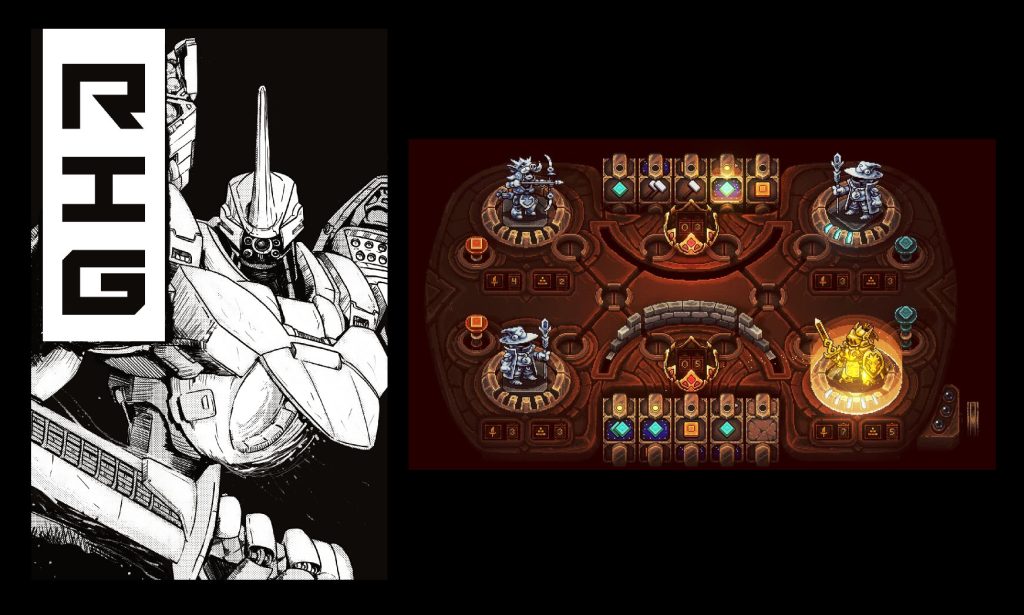
Despite the genre influences of Triple Triad and Tetra Master, the mechanical nature of this game was directly inspired by RIG by Michael Elliot and the Wheels minigame in Sea of Stars. RIG is a solo roguelite mecha game which is itself based on RUNE by Spencer Campbell.
Wheels has a broadly similar concept to Crystal Clash — upgrade heroes to attack the enemy — but its mechanics are very dependent on being a singleplayer videogame and involve lots of rerolling and internal math. It took the elegant high-speed encounters of RIG for me to create a version of the minigame that wouldn’t take up the entire session.
I have played a grand total of one session with this minigame. I anticipate refining the rules some as we experiment with it more (I think we could make it a little faster), but broadly speaking I am deeply satisfied with it. One of my players is enamored with it, and the others tolerate my obsession at the very least, which is a win in my book.