
I was born in the USA, but my parents moved overseas when I was four. Outside of a very brief stint in an international school, the vast majority of my pre-university education was homeschool. When I was around 13, this meant attending an online school. We used an ancient pre-Skype conferencing software called GatherPlace to attend classes once a week and submitted assignments online. Similarly, this meant that my entire social circle was online. My earliest memory of roleplaying was through the school message boards.
Duel
Out of the primordial soup rose the first proto-game, called Duel. The objective was fairly simple: capture the pyramid. Forum posters would describe their characters violently seizing the hill and announce their fortifications, which would serve as obstacles for the next poster to overcome. The rules of this game were written in the blood of heated arguments:
- No all powerful beings — as in beings that can’t be destroyed, or just have excessively huge amounts of power at their fingertips.
- No immortality, or indestructible beings
- No time-travelers
- No beings that have supernatural powers over time and space: Example: The Traveler, from Star Trek: Next Generation
- No weapons that could take out a city — meaning no nukes, bio bombs, death star blasts, etc…
- No mind-control
- No respawn-machine moving
This is a direct quote from an email I sent in 2009. Further rules were amended as players found ways around the old ones:
- Transporters can’t beam through Star Wars forcefields
- Photon and Quantum torpedoes are as powerful as Proton torpedoes
- Using indestructible saran-wrap is off limits.
- No pointing the respawning machine over chasms or things like that.
To get an idea of what the posts were like, here are some brief quotes:
Drakanos is the only one who didn’t seriously get maimed. He wonders why. Perhaps Durge is getting merciful? Anyway, Drakanos walks up to the closest computer, and summons a Rahkshi shield. This shield is made from the parts of all Rahkshi staffs, and so has all Rahkshi powers. He adds it to his default armor, and coats it with Hordika venom, thereby making it as strong as any other Hordika tool. He tosses away his old Hordika sword, accidently slicing through that same bunch of toa who unfortunately fell subject to the wrath of Durge. He walks back down to the spot where both Anakin and Kamik are slowly healing. Drakanos rolls his eyes. Summoning the power of quick healing, Kamik, and Anakin are both healed instantaneously. The Tahaka Alliance is once again, fully armed, and primed for battle.
Note to attackers:
Drakanos’s shield is indestructible because of the Rahkshi power of “limited invulnerability”, but only for a short period of time. But, since it has been covered with Hordika venom, it is indestructible. Why? Because Hordika tools can hold onto rhotuka, right? And rhotuka are spinning wheels of energy right? Therefore, a Hordika tool is made of a metal strong enough to be protected against pure energy, and there is nothing more powerful than pure energy. So Hordika tools are indestructible. Think of them as ancient Sith swords, they cannot be sliced by a lightsaber.
The vast majority of these games were a thinly veiled excuse to engage in powerscaling. “Obviously the Enterprise could take out a Star Destroyer since it has shields and Star Wars ships only have deflectors.” Underneath the nerd circlejerking however, was a burgeoning roleplay culture. While many of us enjoyed playing as pre-existing characters, just as many created original characters.
I’ve been thinking about what it means to have low trust expectations for ttrpgs.
I don’t have horror stories of egotistical 3.5e DM’s or trauma flashbacks to obnoxious kender players. What I do have is a bunch of emails where I got into a fight with my childhood best friend because he used something called a hag mirror to be invincible and we had to amend it to the rules. My attitude towards freeform roleplay emerges from this environment of playground anarchy. It’s not a conscious belief that every player wants to find loopholes so they can become overpowered. However, I do think I have a bias that the default state of roleplaying is chaos, and that rules (formal or otherwise) exist to balance things and generate interesting stories.
The word “balance” is relevant to more than ensuring a 9th level Druid has competitive DPS with a 9th level Cleric. I think it’s equally as important to balance fictional positioning, spotlight, and challenges. There’s a reason we banned Q from Duel even though our game didn’t use numbers. It was important to us that each player had a similar struggle in becoming king of the hill. With that said, balance doesn’t always mean equal — I think the term applies if you’re making a troupe-style game like Ars Magica.
Fictitious
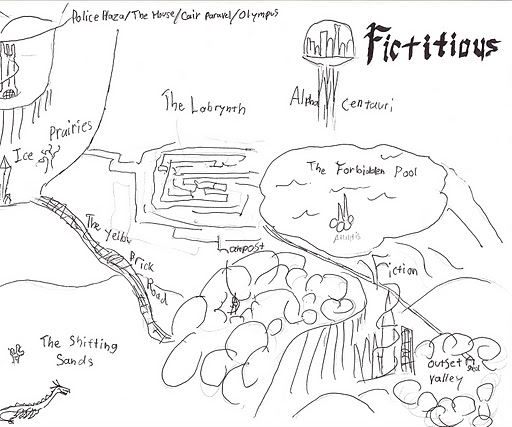
We crossed the Rubicon with our second game, Fictitious. Unlike Duel, there was no “win condition” beyond telling an interesting story. Players would simply pick a character to roleplay in a big crossover setting not unlike The Smash Bros Mansion. It seems like such a small step, but I think this represents the same fundamental shift that spawned Dungeons & Dragons: out of competitive wargames, players began to care about their individual characters. There is a human impulse that wants to pursue imagination beyond winning.
Sadly, most of my writing for this game remained on the forum itself, so I am limited to speculation regarding how it evolved. What I do know is that there was an explicit drive to mark sections of the posts as [IC] (in character) or [OOC] (out of character) as greater emphasis was placed on writing from the perspective of your character — even if the narration was done in third person.
Terra Chao
By late 2012 the roleplaying scene had evolved. Terra Chao was another step forward, requiring original characters and functioning through the efforts of a single game master. Unlike Fictitious, there was an actual (if somewhat vague) plot driving Terra Chao forward and the status quo evolved to an eventual conclusion. Interestingly enough, I played two characters and it was a common practice to have multiple OC’s in play at any given time. This was helpful as you could split into different groups and have a better chance of staying active even if some participants weren’t posting as much.
As an edgy teenager who would not question her gender for several years, I wrote angsty, egg-y characters that seem obvious in hindsight. A boy who hates himself. The world’s coolest girl. Anyway. By this point, I had taken an interest in creative writing at school and my online roleplaying reflected it. Despite the chunibyo subject matter, it’s leagues better than what I was writing for Duel.
Moving slowly, as if he were unsure of reality, he stalked towards the bathroom. He did not
wash his face as he intended to do at first. Instead, he gripped the sides of the sink. His whole
body shook. He stared at the mirror, at his reflection. Gazing at him was the face of a cruel boy
with the soul of a jackal. Miridius tried to manipulate his face, to make it more inviting. Can I
look nice at all? he thought.Aeron had her fists raised for a reason. As if like a snake or a panther, Aeron struck out. She
decked the first boy and threw the second into the third. From there, she proceeded to fight back
with a series of kicks designed to keep them at distance. Miridius could see that his henchmen
and the other boys were suffering badly. They were clearly outmatched by her. She spun in her
elegant, deadly dance, the dance of pain and suffering. Those who stood were destroyed before
her. Those who ran felt wrath lapping at their heels. It was glorious and ugly at the same time.
In retrospect, I think that Terra Chao was an approximation of modern story games. It didn’t have any formal rules, so you could also call it Free Kriegspiel, but I suspect those players would find some objections to our narrative-driven gameplay.
Dungeons & Dragons 4e
While I include this section in order to preserve a perfectly complete record, I do not truly count it as a full roleplaying experience. Sometime during my final year of high school, we decided to attempt Dungeons & Dragons. I think it’s entirely possible that some of us were using different editions without understanding the significance of that. I know I was using a 4e players handbook, and I remember writing the full text of the Prestidigitation cantrip on an index card and deciding it wasn’t worth writing the spells if they were all that long.
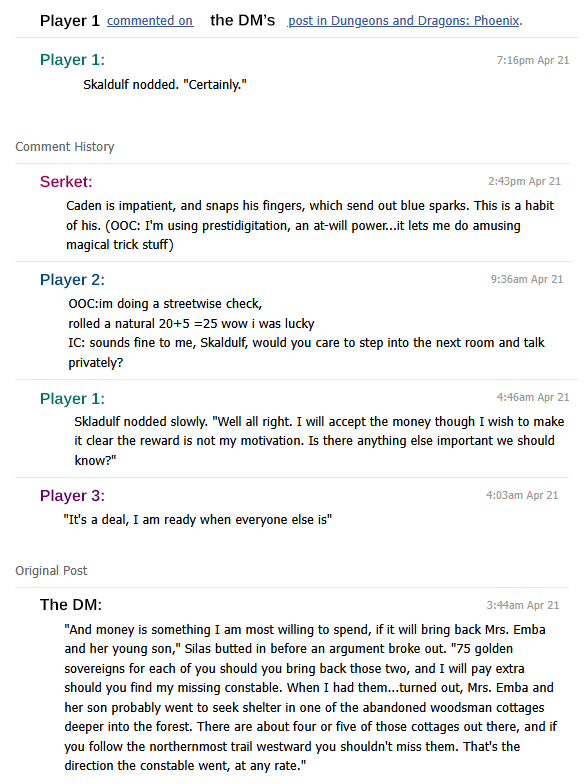
We played on Facebook, which was not yet completely shitty, and I don’t think we ever made it beyond a handful of social interactions. The group that we played in has long since been deleted but I still have a few email records so we can see what it was like. Interestingly, we continued to rely on our forum roleplay etiquette with designations for OOC and IC.
Dungeons & Dragons 5e
I moved to the USA for university (at Texas A&M). The amount of culture shock and interpersonal development I underwent cannot be overstated. It was the first time in my life I was able to regularly interact with peers on a face-to-face basis. I owe a large part of my orientation and survival to the friends I made through tabletop roleplaying.
The very first day after moving into the dorm, I biked through the rain to the local game store. You can’t see it from the street, and there isn’t a sign for it either. It’s through an alley between shops and a small courtyard, with the main entrance facing the rear parking lot behind all the buildings. I relied on blind faith in google maps to guide me.
I was extremely lucky. It was late 2014 and the store was just starting an unofficial Adventurer’s League campaign for Hoard of the Dragon Queen. I got in on the ground floor and started attending every Wednesday. Making friends with the DM eventually led to more games in the future — beginning with classic Apocalypse World, followed by Dungeon World, FATE, and other modern staples.
I don’t really have a conclusion to this post. I’m ending the year with some self-reflection. It’s important to think about where we come from, because I definitely hadn’t contextualized some of my roleplaying assumptions. Going through old conversations and note scraps gave me a real sense of perspective on how my thoughts have evolved over the years.
Anyway. I’ll see yall in a few days for my final post of 2025.