
As part of an organized effort on the Paper Cult forums, I have been playing a variety of games in short 3-session campaigns to “Meet The RPG“. It’s kindof like a book club, but for games. Our first game of 2026 was Beam Saber, a Forged in the Dark mecha game by Avalyn Ramsay.
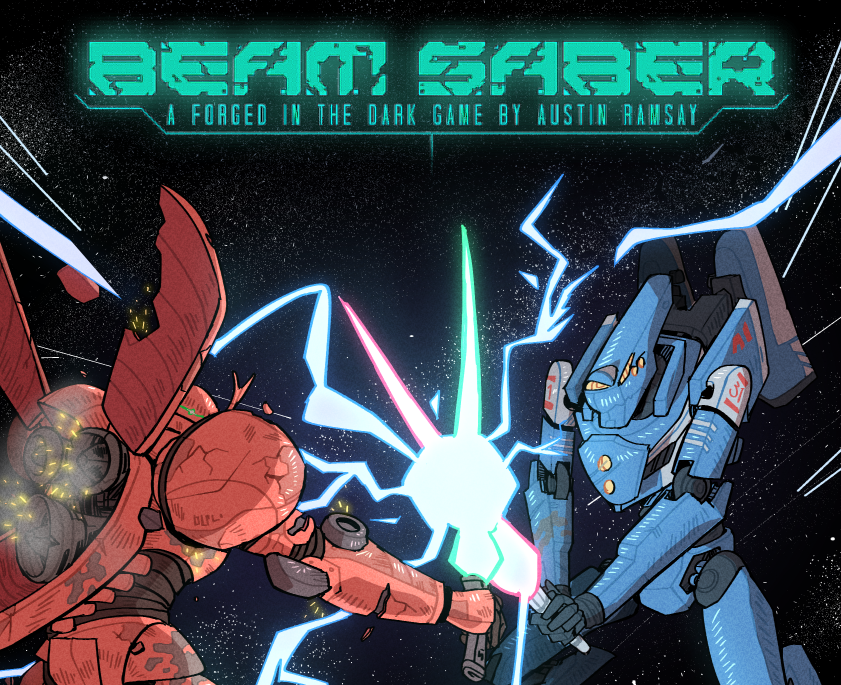
I’ve played my fair share of mecha games — including one for this group — and I will continue to play more mecha games in the future. The question of the hour is what Beam Saber has to distinguish itself from its peers and why you should choose it over them.
bad ends in the dark
Forged in the Dark games are a war of attrition. Your characters accumulate stress, damage, scars, and trauma which snowballs into further wear & tear. These injuries are something that can be treated with downtime activities, making it an opportunity cost to tread water or engage with things you actually want to be doing — like long-term goals and personal objectives. Spending time taking care of yourself also means you forfeit chances to improve yourself, which makes things more difficult in the long run as the difficulty increases. All of these things culminate into a doom spiral that you play chicken with. The goal is to last long enough to achieve the ending you want for your character.
In traditional Blades in the Dark, this was done through the accumulation of wealth: the amount of coin in your stash when you retire determines the quality of life post-retirement. This functions almost like a high score in a video game.
Beam Saber is a little different: pilots have drives, like “Kill the man responsible for destroying my hometown” or “Become a famous pop idol”. Whenever they do something towards accomplishing that drive, whether in a mission or during downtime, they add a tick to their drive clock. Drive clocks may be spent in the following way:
- Spend 1 Drive Clock to negate Harm or Damage of any level, change an action roll or fortune roll result to a 6, or give another Pilot all four benefits on an assist.
- Spend 2 Drive Clocks to change the life circumstances of one person. This is the only way to permanently defeat a Rival.
- Spend 3 Drive Clocks to change the circumstances of a squad.
- Spend 4 Drive Clocks to change the circumstances of a Faction.
Two 4-step clocks are required for a single character to retire like in Blades. Notably, the drive does not have to be relevant to what you spend them on — this is seen as sacrificing your individual dream for something else. Choosing a drive is interesting because it simultaneously makes a specific goal both more difficult and mechanically achievable. For example, in a normal game, you might be able to use a Long-Term Project to get a high-ranking position in the military. However, if you make that your drive, then the Long-Term Project might fill one tick of a single drive clock.
I think a lot about the Expressionist Games Manifesto. The characters of Beam Saber have desires in a world — in a system — that actively works against their fulfillment. I don’t think that is a flaw of the system. Beam Saber excels at tragedy. Once you start embracing the idea that we are putting blorbos into the blender, and that we’re excited to see the mess, the system clicks. My goal with the game is to apply enough pressure to produce Kamille Bidan at the end of Zeta Gundam.

genre by the playbook
Despite the overwhelming mood set by the game’s systems, what I found interesting about Beam Saber is the wide spectrum of activities it accommodates. During one of our discussions of the game, we noted that crew playbooks in Blades in the Dark mostly determined what flavor of scoundrels you were going to be. Contrast this with the squad playbooks of Beam Saber:
The Consulate squad spreads propaganda and manipulates expectations. Their “battles” are fancy balls with politicians and generals, speaking for their faction while gathering intel. Espionage and negotiation are the primary mission types, and they mostly operate outside of their vehicles.
The Mechanized Cavalry squad is the more traditional approach to mecha, with a heavy focus on the vehicles. Their abilities and upgrades help them in direct combat, and most of their missions will probably be straightforward confrontations.
These are two out of the eight base squad playbooks for Beam Saber, and each one suggests a wildly different gameplay focus that affects player engagement with certain mechanics. For example, because we chose to play as a Mech Cavalry squad, we didn’t spend much stress at all due to the way vehicles expend quirks to push themselves. This means that we didn’t have to worry about cutting loose during the first downtime, which also meant that the connection clocks didn’t increase and we saw less inter-pilot bonding scenes. It wasn’t until the third session when we intentionally made an effort to engage with pilot mechanics that one of our players had a Cut Loose scene (and eventually stressed out during the mission).
Ultimately I think this is both a strength and weakness of Beam Saber. The game operates almost like a universal roleplaying system for mecha, able to handle a wide variety of squad types and mecha activities. However, the variability means that the other parts of the system can’t be tailored as tightly to support specific experiences, and committing to a playbook can unintentionally affect your engagement with many of the game’s mechanics.
I had a good time playing Beam Saber, and I would recommend Beam Saber to a lot of people and even play it again under the right circumstance. However, I don’t really like the system itself due to the inherent nature of Forged in the Dark as a descendant of Powered by the Apocalypse. Games like these embrace the concept of “fail forward” in a way that tends to frustrate me rather than contribute to a positive storytelling experience.
As a player, partial successes feel overly-punitive and de-incentivize me from engaging with the mechanics. I find myself trying to accomplish things without rolling the dice, because there’s a 2/3rds chance that something bad will happen. This is the point of games like this, and I’m not a fan.
As a GM, failing forward acts as unwanted momentum for the timeline of events. I tend to have very specific ideas about what will happen if players fail or succeed, and partial successes demand a constant barrage of changing circumstances that throw off my pacing. If players get full successes, it pushes me “behind schedule” because there are no strict turns and I am limited to changing the fiction through reactions.
These pain points are not specific to Beam Saber, which is why I place them here at the end. I would still choose Beam Saber for many things — in particular, the game thrives with a strong political angle and has rules for multiple factions and squads. I’m just not sure any of those games would be my first choice for mecha fiction.